Interview with Mathieu van der Poel by Miriam Terruzzi
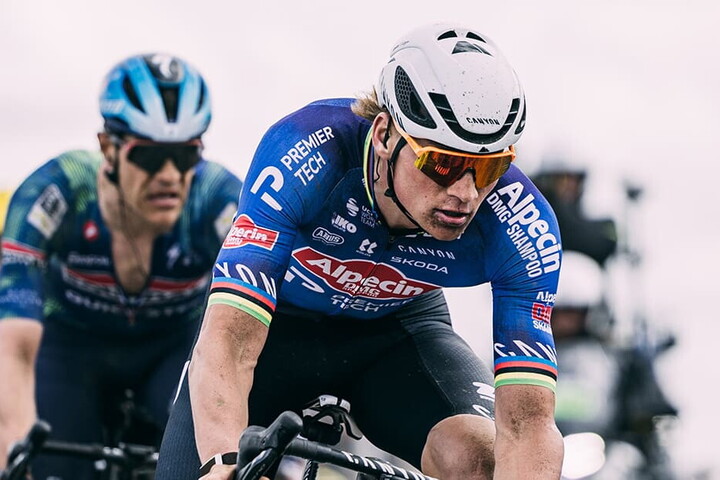
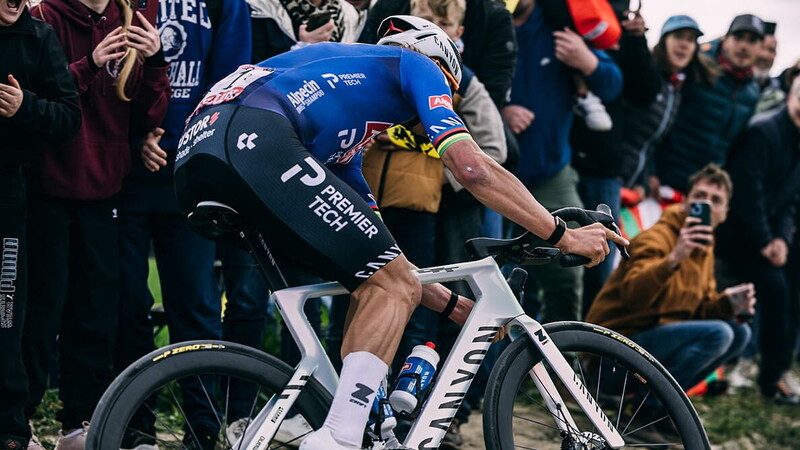
Tilted handlebar levers and an immaculate white sock framing the calf – MVDP's riding style is that of a man born to it, one who seems to move according to a personal vision entirely his own. His ice-cold eyes and sharp profile call to mind the image of a hero from another era, a legendary figure carved into the collective imagination as a synonym for invincibility, capable of making the impossible prevail over logic when it matters most.
But following instinct, for him, does not mean abandoning rationality. In 2026, the cyclist has learned to look inward with a clarity that is both cutting and profound. It is the composure of the truly exceptional athlete, combined with an almost mystical awareness of being guided by a higher design.
Flair and inspiration
MVDP is not simply a rider who has won races. Like Gilles Villeneuve in Formula 1 or Michael Jordan in the NBA, he is someone who has drawn a line between before and after – someone who has managed to redefine what cool looks like. With him, multi-disciplinarity becomes possible; the sock becomes aero, the handlebar levers bend until they resemble a draughtsman's compass and the all-white kit becomes a statement. The bicycle becomes an extension of his body and, as such, an integral part of an aesthetic that could only ever be his. He is MVDP and people want to be like him. So when asked about his own sources of inspiration, his answer is almost self-evident: “I just try to be myself, on and off the bike – I think that's very important. I simply do everything I can. I've never really thought of myself as a role model or anything like that. I just think about enjoying it, because it's something I truly love; it's part of who I am. As a cyclist, the love for the bike is everything. You spend so many hours in the saddle that you could never compete at the highest level if you didn't genuinely enjoy going out every day, even just for the pure pleasure of it.”
And so love is once again the measure of all things, even in a sport as brutal as cycling – where romance has an iconography entirely its own, and suffering is the language of the only poetry we know. How could any sacrifice be more sublime than one born from this?
Power is nothing without control
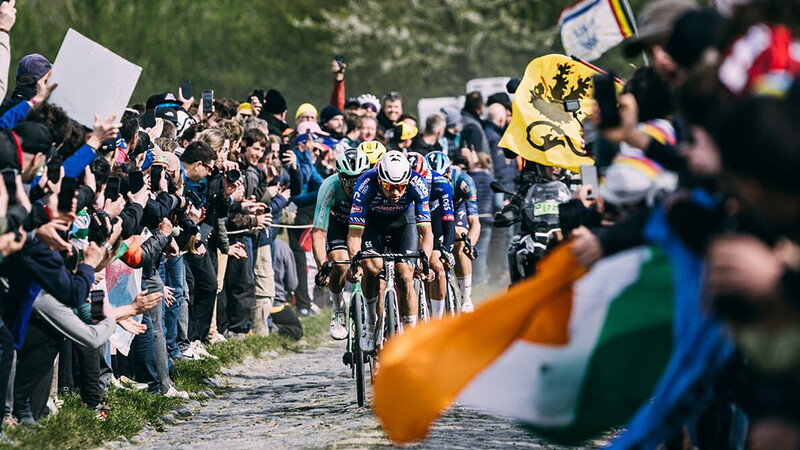
If two classics exist at opposite extremes, they are Milano-Sanremo and Paris-Roubaix. The first, a flight towards the Riviera dei Fiori; the second, a cobbled route through hell. One all light, the other all shadow. Two contrasting races that MVDP has mastered as few others have, keeping power under control across terrain that is extraordinary in such different ways.
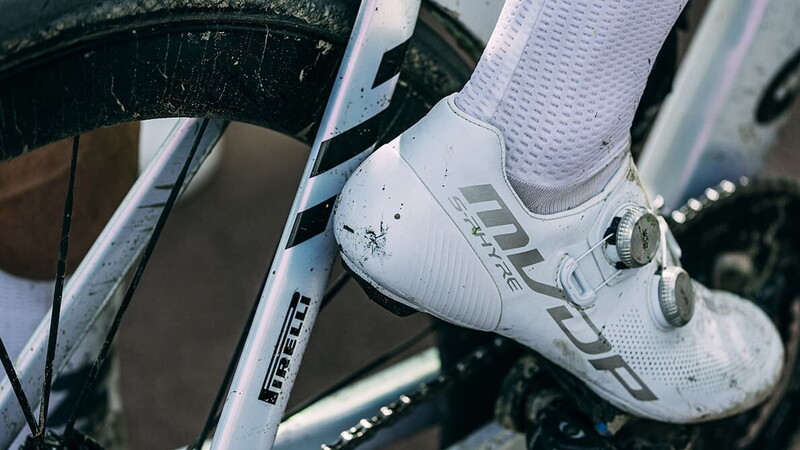
“They are two very different contexts, obviously,” he says. “But the key climbs at Sanremo – the Cipressa and the Poggio – are both followed by treacherous descents, and having grip there, and not losing your head, is absolutely critical. When you're talking about Paris-Roubaix, you enter a world apart. It's an extremely demanding race, made almost brutal by the passage through the Arenberg Forest – a place that was never meant for cycling. In a race like that, you have to constantly play with tyre weight and, above all, tyre pressure. It's a subtle and very personal challenge, because in the end it all comes down to feel. If you're looking for an [element] of comfort to avoid being shaken apart by the vibrations, you have to run low pressure – but everyone knows that every half a bar less increases the risk of punctures. You have to find that fine balance.”
Reading the mud
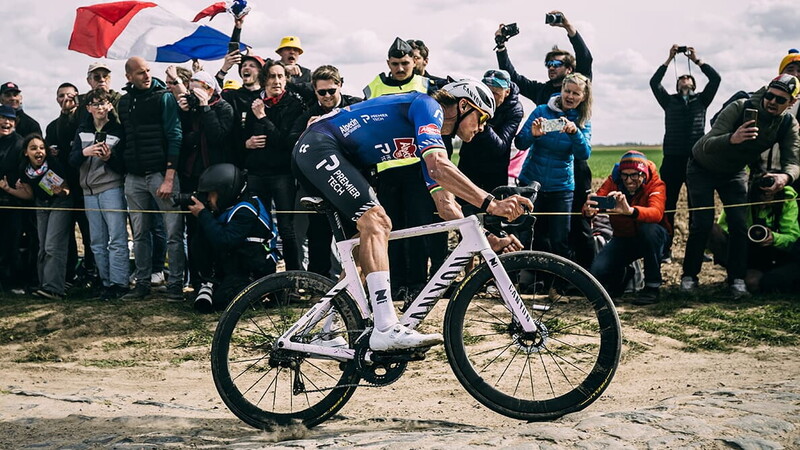
“I've always been in the habit of observing, ever since I was young,” he explains. “I think you learn it from cyclocross, obviously. But I've been doing it all my life, so I believe it's something innate.”
How he does it, even he cannot say. Understanding the mud, sensing its consistency – more slippery, more clumped, viscous as oil or sticky as honey. The conditions are not all the same; the mud at Namur, for instance, is so black it feels as though you're sinking into pitch. Yet he has a gift for emerging from it immaculate, as if he were flying above the surface. Is this not the Holy Grail for which everyone who takes part is searching? The perfect connection between terrain and athlete – that bond which determines balance. “Knowing your tyre pressure,” he continues, “which tyres to use, reading the mud, the lines and everything else. You learn it by doing it, and it's an aspect I've always enjoyed getting right. On sand, too, for example, it's really enjoyable to have – and to think through – different line options, so it's always something I pay close attention to. Obviously, there are certain things that make me feel more connected, in a way. Tyres, naturally. But it's hard to explain that connection – it's more a matter of feel. And, of course, in cyclocross, as in mountain biking, there's far more work to do compared to road racing. Only in races like Paris-Roubaix, or the cobbled classics, can you play a little with tyre pressure; for the rest of the year it's all fairly constant. Whereas in cyclocross or mountain biking there's much more variation and you can be more creative, in a sense.”
MVDP has never hidden his love for mountain biking, a discipline in which instinct and reason complement each other like yin and yang. Choosing a line – or creating one – demands enough clarity to decide and enough bravery to risk it.
No Plan A
Is strategy perhaps part of the risk? MVDP seems to have a leader's eye for everything – someone who plans his race according to instinct, yet methodically, without anything seeming particularly difficult. But if everything flows smoothly on the outside, the complicated part on the inside is finding the balance to dominate the race while also controlling oneself.
“Managing myself is perhaps easier,” he explains. “After a while, through experience, I can tell very early on whether it's going to be a good or a bad day. But the race itself and the tactics are another matter entirely – it's always complicated. So many things happen during a race that I always try to go on instinct, and I never really make a plan before the start. I know, of course, that there are key moments where you need to be at the front, but for the rest I let intuition take over. This approach works for my head – it keeps me relaxed, because I'm simply ready for every scenario.”
He is, however, fairly sceptical about whether this strategy remains effective in modern cycling, which seems to leave little, if anything, to the imagination, except in certain luminous flashes.
“I think nowadays it's simply about being the strongest. I believe cycling has changed somewhat in recent years; tactics aside, you just need exceptional legs to win a race. And I've certainly had races where I felt exceptional and the tactics probably weren't that decisive in the end.”
His performances have accustomed the cycling world to a way of winning that is assured and linear – attacks like solitary breakaways, no miscalculation in the timing of the move and the execution that follows. Yet every cyclist – and every person – evolves and adapts to dynamics that keep shifting.
“I don't think it's just me that has changed, but also the way races are ridden in general. A few years ago it was almost unthinkable that the decisive move at Milano-Sanremo would come on the Cipressa, yet for two years running now you need to be at the front there. At this year's Ronde van Vlaanderen [in Belgium] the decisive move came 100km from the finish, so there is never a moment's respite. You have to be ready at all times, or you'll miss moves like that.”
Just as the American poet Jack Kerouac did with The Duluoz Legend, MVDP is writing his own personal story as one great book that reveals the complex design behind each individual victory. “If I close my eyes,” he concludes, “the first image that comes to mind when I think of a happy moment is the victory at the [2023] World Championships in Glasgow. A sporting achievement, but a personal one, too – especially after what had happened the year before in Australia. It was an emotional, beautiful moment, and for me perhaps one of the greatest milestones of my career… so far.”
And there it is – his great, blazing, unfinished constellation, still gazing at it with passionate detachment. The snow swirling above the hollow of Zonhoven or the shaft of sunlight reflected in a puddle on the final bend of that Scottish circuit.
North. Further north still.
Photo: Tornanti.cc