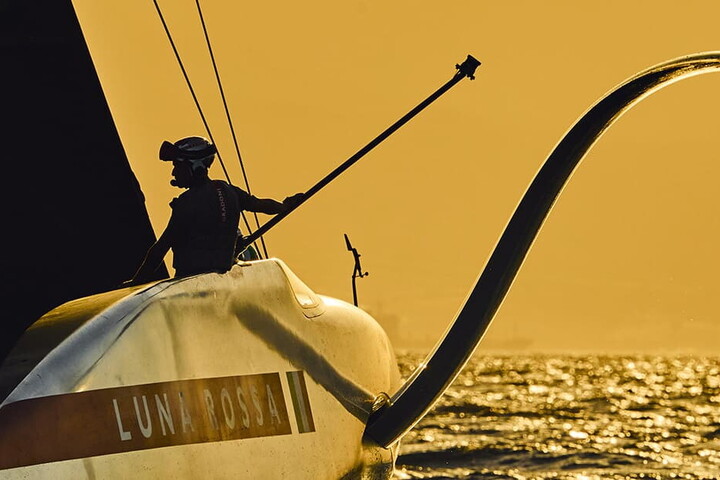
The world's most renowned sporting institutions are anything but discreet. By their very nature, they are designed to be visible, distinctive and instantly recognisable. This is even more true when it comes to the boats competing in the America's Cup. These are engineering masterpieces that push the limits of physics and challenge the forces of the sea; they are icons in their own right. Yet behind every hull and every racing campaign stands a team of highly specialised professionals working far from the spotlight, transforming expertise and experience into performance. We are talking not only about designers and engineers, but also about specialists whose roles may seem far from sailing itself – maintenance technicians, painters and data analysts – whose contribution is essential to ensuring that these boats achieve and maintain peak performance. To understand what it really means to work on a project of this scale, we spoke with some of the key figures from the departments that form the beating heart of Luna Rossa.
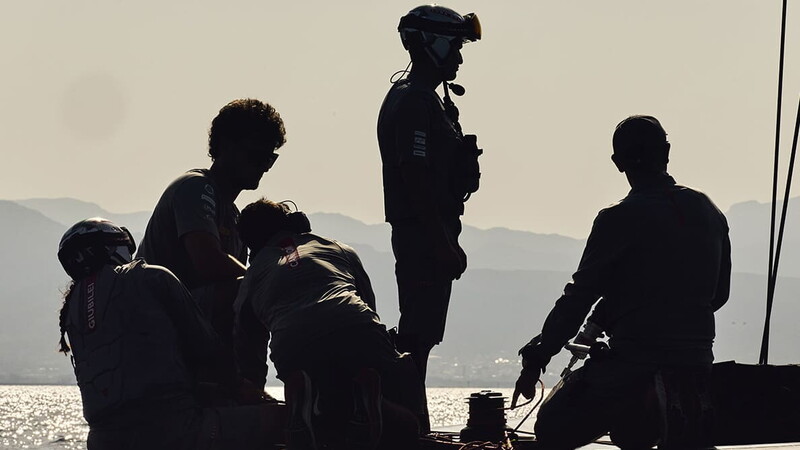
Take Alessandro Franceschetti, Luna Rossa's head of structure. From his words, we learned that a team of this calibre must “think like an orchestra, in the sense that there is a continuous loop between the various departments”. According to Franceschetti, Luna Rossa enjoys a significant advantage over many competitors: “Continuity. We've had the same backbone for almost 30 years and that continuity is incredibly valuable.” The same principle applies to the partnership with Pirelli, which opens up new possibilities for research and development. “With Pirelli,” Franceschetti continues, “we are able to experiment with innovative solutions. We have access to a much broader portfolio of materials and applications than those typically available in the marine sector, as well as tools and technologies developed in other fields, foremost among them motorsport. That too represents a tremendous advantage.”
For Michele Cannoni, boat captain and shore team director, communication and collaboration between departments are among Luna Rossa's greatest strengths. “We work on shore and take care of the boat's maintenance, treating it as if it is a patient and we are its doctors. So, we think and act as a team, as a crew. Or rather, as a rugby team. It's the best comparison I can think of because we constantly rely on one another. There are times when one person has the energy to push harder and others when that same person is exhausted and needs support. Being able to step in for one another and provide mutual support creates a bond that becomes essential during periods of intense pressure.”
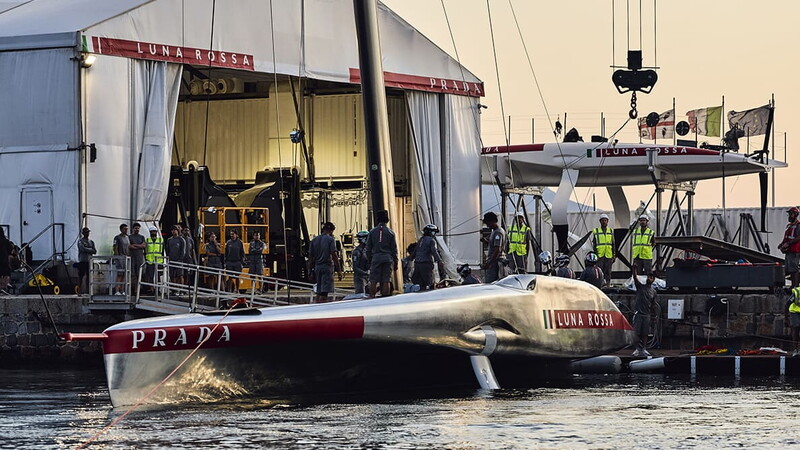
The pressure is on to make sure the boat performs – and can stand up to the stresses of racing as well as harsh weather conditions. Michele Bella is head of sail loft and his role directly influences the performance of the sails, the boat's primary source of propulsion. “Today's sails incorporate electrical cables and hydraulic lines, which means we need to work closely with every department, especially when tensions run high,” he says. “At times, discussions can be intense, but they are always driven by a common goal: improving the boat's performance. Boats have changed dramatically over the years. Now that they are so fast, it is extremely rare for a sail to blow out. In the past, however, it happened frequently and we would spend entire nights gluing, stitching and carrying out repairs.”
Change is another central theme. America's Cup boats evolve from one edition to the next, and alongside them evolve the technologies, skills and professional expertise required to achieve such extraordinary levels of performance. Marco Capitani, Luna Rossa's head of sails and aero, offers a perspective that bridges past and future: “We have moved from an era in which sails were designed using photographs, pencils and set squares to one in which advanced software allows us to perform countless simulations, configurations and tests in preliminary phases. New materials have been introduced and boats continue to get faster, which requires entirely different sail designs.”
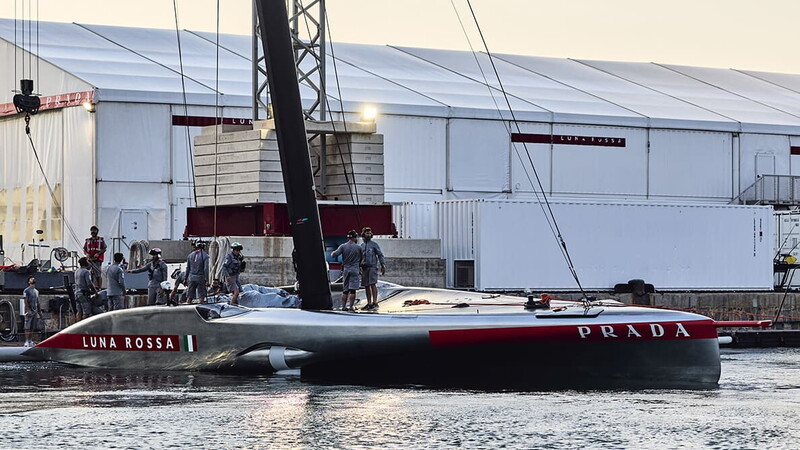
Another important aspect – particularly for a project like Luna Rossa – is the relationship between performance and aesthetics. “When designing a sail,” Capitani explains, “the primary objective is always the same: helping the boat go faster. At the same time, however, we represent an important brand, so we must also express the style and identity that distinguish us as Italians. Beauty and speed can coexist.” The idea – ambitious, almost Utopian, yet one that becomes reality at Luna Rossa – that aesthetics, functionality and performance can advance together drives the work of Mauro Zamichele, a key member of the paint department. “Making Luna Rossa beautiful is a way of completing the circle and adding value to everything we do,” he notes. “Yet behind every decision involving paint systems and finishes, particularly after racing, lies a constant commitment to achieving the highest possible performance. Every component we work on must interact perfectly with the water. Our job is to guarantee durability, reliability and consistency. Even the smallest imperfection can affect the boat's performance and, consequently, the team's results. To avoid any issue, research and development plays an important role in our department as well.”
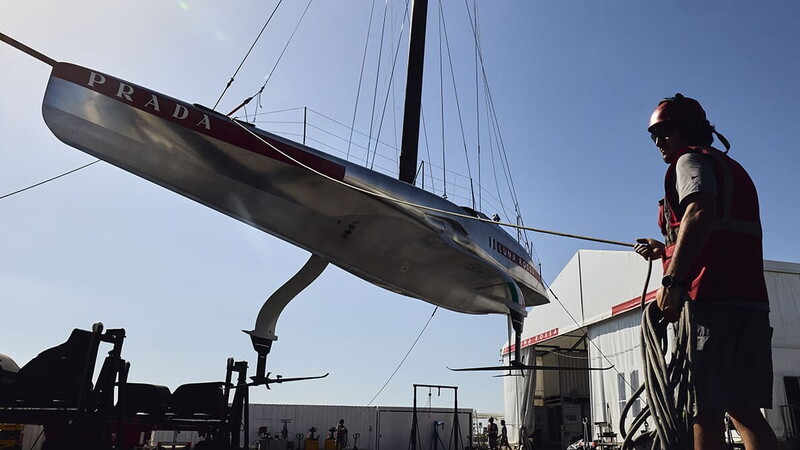
The insight about research and development is meaningful. Every team member performs highly specialised work based on precise data, rigorous analysis and highly accurate projections. In such an environment, data science becomes essential. Matteo Ledri, head of computational fluid dynamics and performance, explains that his department collects data directly from the water to “validate the simulations developed during the design and development phases. With the tools and technologies available today, we can compile reports in a fraction of the time that would once have been required. But the greatest satisfaction comes from seeing an idea developed on a computer perform successfully on the water.”
After all, for those working behind the scenes, that is often the ultimate reward: witnessing theory become reality. Even more so when that reality takes the form of a project like Luna Rossa – a beautiful, distinctive and powerful boat that owes its success to a team whose expertise and professionalism are second to none.
Photo: Carlo Borlenghi