In Denmark, the bicycle is not merely a mode of transport; it is a fundamental part of the national identity, reflecting a country long committed to combating climate change through light mobility. Pedalling is a way of life. Whether commuting to work, taking children to school or simply enjoying the city, the bicycle is the symbol of a simple, healthy and profoundly hygge existence — a word that encapsulates the quintessentially Danish philosophy of finding happiness in life's small daily pleasures. It is no coincidence that this Nordic nation boasts one of the most extensive cycle networks in the world, with a total of 12,000 kilometres of bike-friendly routes. One of the most famous is the Kattegat Cycle Route, a journey of over 400 km named after the 30,000 km² stretch of sea between Denmark and Sweden that links the Baltic to the North Sea.
The path traverses the Eastern coast through sandy beaches, forests and small fishing ports, connecting Copenhagen to Skagen. This long and fascinating route allows travellers to discover cultural and scenic beauties of remarkable interest, starting with the capital, a city that can rightfully be considered the spiritual home of the bicycle. Beyond Amalienborg (the Royal Family's residence), the merchant harbour with the famous Little Mermaid and Rosenborg Castle, attractions include the celebrated Tivoli Gardens - one of the world's oldest amusement parks, opened in 1843. Leaving Copenhagen behind and heading North, the landscape opens up towards locations such as Hornbæk, a renowned seaside resort favoured by families for its calm waters and shallow shores. Continuing further, one encounters a series of villages like Gilleleje, a charming fishing town where boats, fish markets and characteristic low-built houses preserve local traditions.
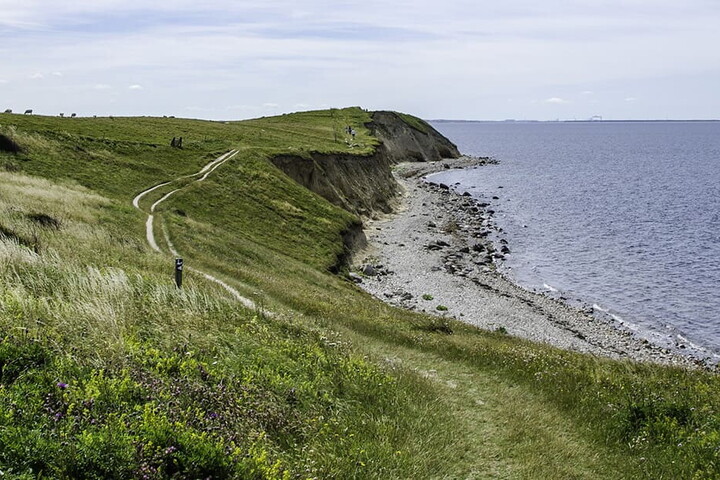
Between the wind, sand and water, following the silhouette of the Kattegat brings one into contact with the natural elements that build, destroy and remodel the coast season after season. Between coastal stretches, the route dips into wooded areas such as Thy National Park. This is Denmark's oldest national park, set in a rugged and wild coastal region where over 200 km² of trails can be explored on foot, by bicycle or even on horseback, through forests, verdant dunes and wide sandy beaches. The park is home to abundant wildlife: red and roe deer roam freely across the moorland, while seals, cranes and white-tailed eagles can be spotted along the coast.
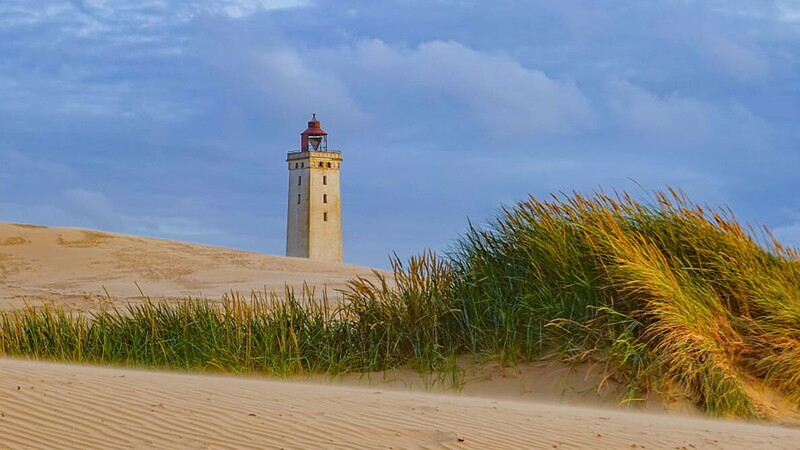
Beyond the wild flower meadows, fishermen's cottages and pristine beaches, the rhythm of the journey is marked by spectacular lighthouses scattered along the route, such as the Rubjerg Knude Lighthouse — one of the country's most popular attractions, Opened in 1900 near the remains of Mårup Kirke (an ancient church from 1250 dismantled in 2008 before it could collapse into the sea), the lighthouse was at risk of being swallowed by the waves due to coastal erosion. Fortunately, a local “hero” managed to extend the building's life in the autumn of 2019 by constructing special rails to move it 70 metres inland. Today, it remains an essential stop for anyone visiting North Jutland, alongside the church ruins and the anchor of a British frigate that sank here in 1808.
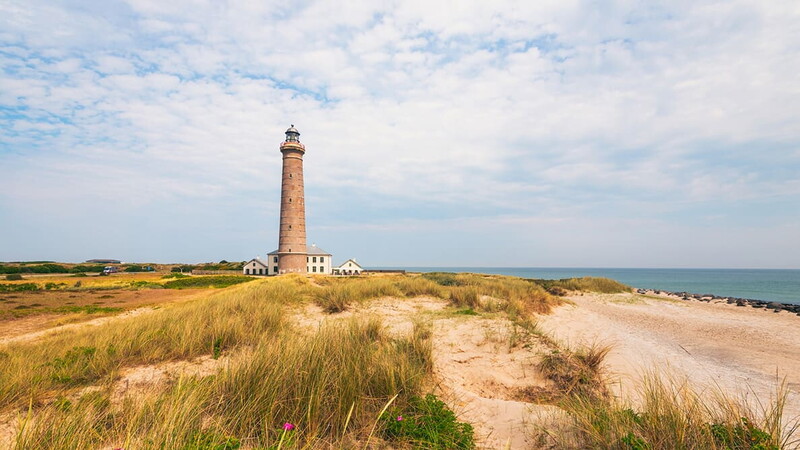
As you approach the Northern tip of Jutland, the quality of the light changes. This was famously captured by painters such as Peder Severin Krøyer of the Danish Impressionist circle. With his soft brushwork and a palette of cerulean and sand tones, he immortalised this diffused luminosity, capable of transforming the landscape into a sensory and aesthetic experience. The works of Krøyer and other 19th Century local artists are housed in the Skagen Museum, the final destination of the cycle route. The journey concludes at the Northernmost tip of the European continent, where the Kattegat and the Skagerrak meet and mingle their waters, creating a rare and evocative natural boundary. Sand and sea shape the landscape around this fishing town, which is often weathered by the elements. Among the most famous sites affected by erosion is St Lawrence's Church, better known as the "Buried Church". When built in the 14th Century, it was the largest in the region. Two centuries later, however, massive sand migration caused the building to be repeatedly buried, leading to its closure in 1795. Today, only the tower remains visible. In contrast, Skagen's Grå Fyr (literally the “Grey Lighthouse”) stands tall; it is one of Denmark's highest lighthouses, second only to the Dueodde Lighthouse on Bornholm. Climbing the 210 steps rewards you with a breathtaking view of the wild nature and the iconic yellow houses with their red roofs and white windows: a spectacle that is certainly worth the journey.