Raghu Rai photographed India from 1965 onwards, documenting its public and private life for more than sixty years. For the 2027 Pirelli Calendar, he had chosen to pair images from his own archive with faces of contemporary India, working on the project until his passing in April 2026. His daughter Avani Rai chose to continue his work, following a deeply personal approach. She took Raghu's archive photographs, both published and unpublished, out of the studio and placed them back in the streets of Delhi and Mumbai, alongside the people who live in those places today. People, architecture, movement, light and rituals thus enter the photograph, while the cities become a living presence within the images. “My father belonged to the street. That's why I took the idea he was working on and brought it back to the streets, among the people he had photographed all his life”, says Avani. “I take a step back, spiritually and literally. I stand behind him”.
Avani, what did working on this Calendar mean to you?
It was an incredibly personal and emotional journey. My father, Raghu Rai, had been working on the project for several months before he passed over. I felt a deep responsibility to carry it forward, but also a need to find my own way into it. Picking up the camera after he passed over was one of the most significant moments for me. I began by searching for myself, and for him, and in that process, found a way to honour what he had begun while remaining true to how I see the world. He always believed that imitation could never take you beyond the original. What he left me was something far more profound: to look at the world with a warm heart, an open eye, dignity and respect, and to carry his legacy with grace.
What was the idea your father had developed?
He had imagined bringing the past and the present into conversation through his photographic archive. His idea was to create studio portraits in front of a selection of his unpublished photographs, allowing different moments in time to coexist within a single frame.
How did you take the project forward?
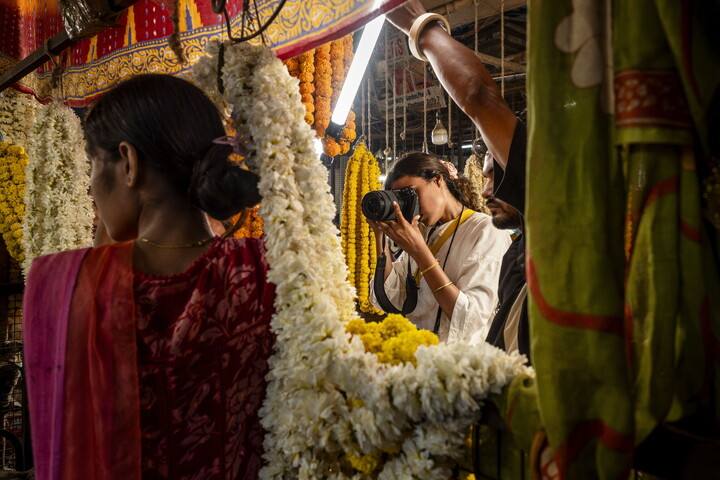
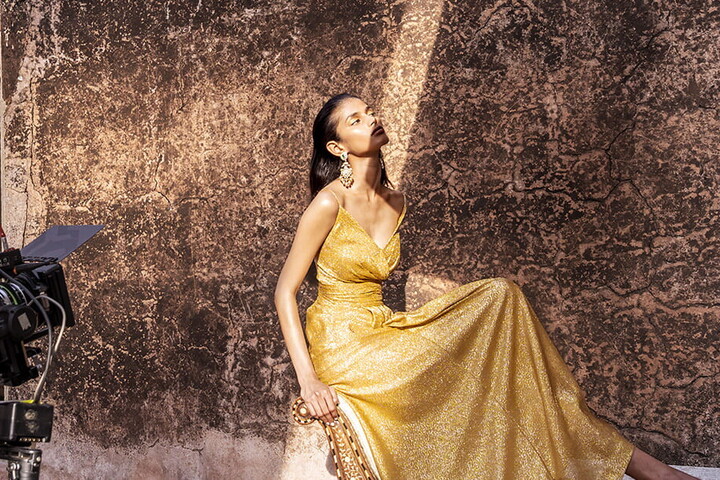
I realised that, for me, honouring his legacy meant looking beyond the photographs themselves and trying to understand his way of seeing. My father belonged to the street, among the people he had photographed all his life. So I took the idea he had developed out of the studio and returned his photographs to the places where they were made. His original, unpublished photographs remained intact within the frame, and I stood behind him, almost making him invisible, as I photographed the world of 2026 unfolding around his images. In doing so, I wanted to bring together the many realities that make up India, where caste, class, gender, community, textures, expressions, beauty and intensity coexist. The past and present inhabit the same frame, each retaining its own life, yet becoming part of a larger whole.
Which places did you choose?
We returned to the places in Delhi that my father loved and photographed throughout his life. With the help of his longtime driver, Nandan, we retraced his routes through markets, historic neighbourhoods, crowded streets and along the Yamuna. He was always drawn to the transformation of cities, particularly to the things that were at risk of disappearing. In Mumbai, we moved into a different rhythm of the city, from its contemporary architecture and spaces inhabited by young people to its older neighbourhoods and fishing communities. What interested me in both cities was the coexistence of different worlds, often within a few streets of one another. These are places that are constantly changing, yet carry so much of their past within them.
People also play a central role in the project.
Absolutely. My father photographed people from every background, religion, age and profession with the same curiosity and dignity. He never separated the extraordinary from the ordinary. A musician, an artisan, a child on the street or a dancer could all become part of the same frame. He had an extraordinary ability to recognise how different realities could exist together, without one diminishing the other. I wanted that sense of humanity and coexistence to remain at the heart of this project.
What was it like working with Sølve Sundsbø?
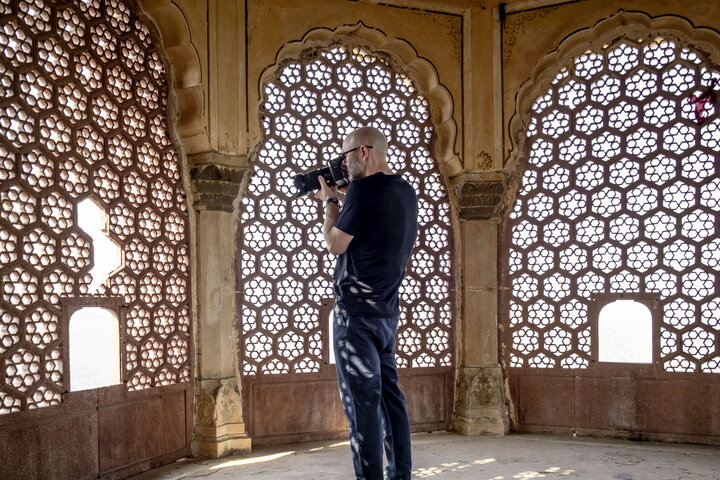
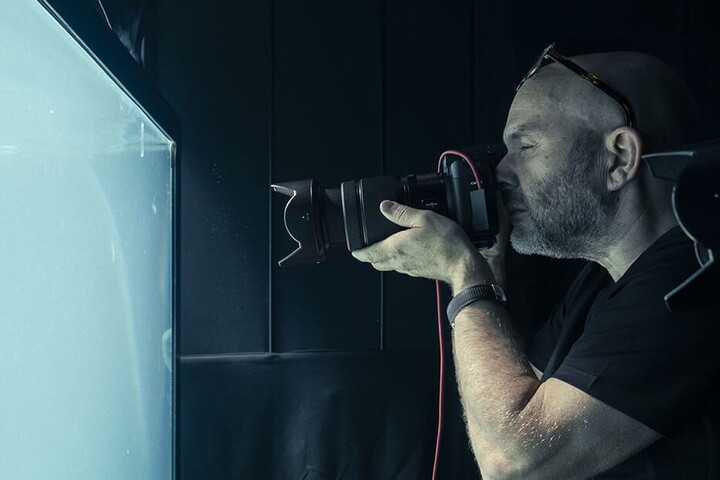
There was a constant conversation between Sølve and me, but also with my father and the ideas he had left behind. Although he was no longer physically present, his work was part of every decision I made. In a way, it felt as though three artists were in the room: two of us physically present, and one continuing to be present through his photographs.
You have said that through photography you keep meeting your father. What do you mean?
When I look through the viewfinder, the world seems to slow down. We live in a time when imagery is being produced constantly, when technology moves faster than ever and life rarely pauses. For me, the camera asks me to do just that: to wait for the extraordinary within the ordinary, which is something I learnt from my father. In that waiting, I find a complete silence, even when there is
chaos all around me. It is in that silence that I begin to have a conversation with him. There is a gut instinct, a skip in my heart, when I know the moment has arrived. And I click. That is where I meet my father, in the slowing down, in thee waiting period.
He never taught me how to photograph. He taught me something far more fundamental: how to be alive to the world around me. To observe, to wait, and to remain open to what might unfold. He taught me that a photograph cannot be forced; you have to be present when life reveals itself. I think that is what I continue to look for, and what keeps bringing me back to him.