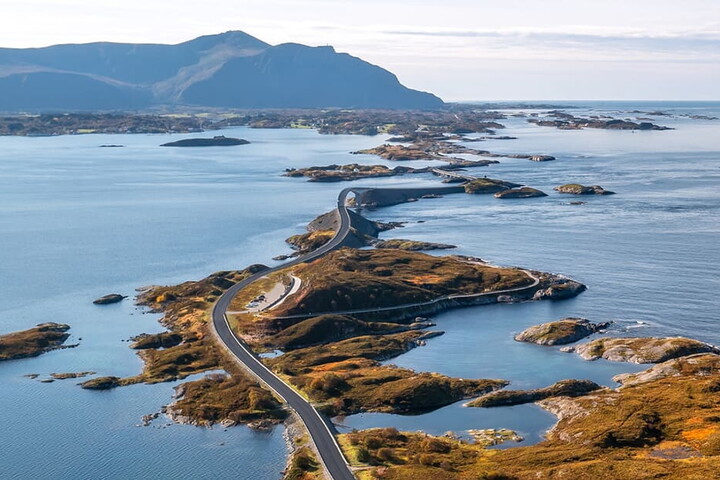
Mountains, glaciers and deep fjords along the coast: these are the defining characteristics of Norway, as well as the natural elements that contribute to the unmistakable allure of a country that has always contended with extreme climatic conditions. It is a land that demands the necessity of bending a harsh, mysterious and sometimes inaccessible nature to human needs. An exemplary expression of this attempt to coexist with seas, winds and ice is the Atlantic Ocean Road, an 8.27 km stretch of road connecting the Norwegian cities of Kristiansund and Molde, in the western fjords. Not merely a link road, but a journey between sea and sky where eight bridges connect small islands facing the Norwegian Sea in a spectacular sequence of curves suspended over the water. Here, the journey itself becomes part of the spectacle as one crosses an extraordinary landscape.
The project, as originally conceived in the 1920s, was intended for a railway line. However, due to the inherent dangers, the idea was later abandoned in favour of a road route consisting of a series of raised sections, viaducts and bridges, set between islets and skerries. Construction, which began on 1 August 1983 and was completed on 7 July 1989 at a cost of 122 million Norwegian kroner - an investment partially offset by tolls imposed over the following fifteen years before being removed in 1999.
Elected "Norwegian Construction of the Century" in 2005 and defined by The Guardian as the world's best road trip in 2006, the Atlantic Ocean Road is famous not only for its design - a succession of bends where the asphalt skims the water's surface - but also for its peril, dictated by often adverse atmospheric conditions. Strong winds and violent storm surges, where waves frequently wash over the tarmac, mean the road is not passable year-round and demands significant attention from those who choose to experience driving in such an extreme location. When the sea is calm, however, everything changes: the water turns into a mirror and the landscape assumes a state of almost suspended stillness. These are two opposing souls of the same scenario, inviting visitors to discover this stretch of road in different weather conditions, provided due caution is exercised.
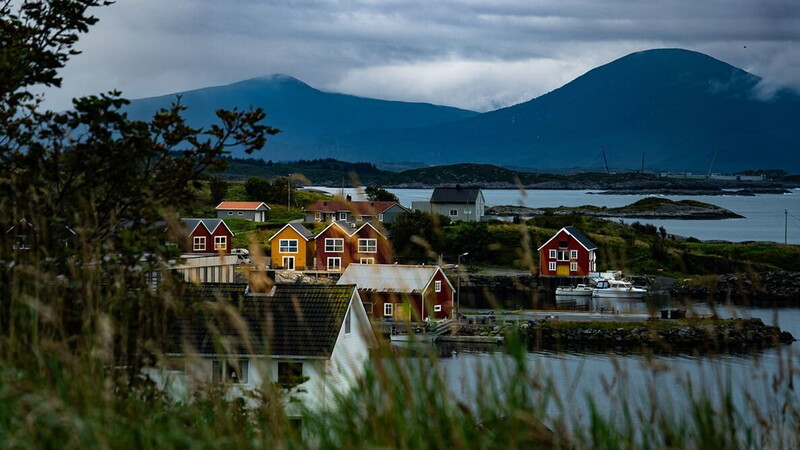
Despite the brevity of the itinerary and its relative danger, the Atlantic Ocean Road is today a highly popular tourist attraction, thanks to several vantage points dotted along the route, where one can stop to breathe the salt air and listen to the sound of the sea. In particular, the small islands scattered along the path preserve the authentic identity of the Norwegian coast. Among the characteristic colourful fishermen's houses and small harbours, one can experience a culture tied to the sea and its rhythms: an opportunity to connect with a simple but deeply rooted tradition.
Tourists are also naturally drawn by the adrenaline rush of driving "within the belly of nature". Of particular interest is the Storseisundet Bridge, 260-metre-long cantilever bridge rising 23metres high. At its apex, it features a sharp curvature that creates an optical illusion, hiding the second half of the road and giving the impression that it simply ends in mid-air. For this reason, it is jokingly nicknamed the "drunk bridge". Behind such theatricality lies a complex engineering project capable of withstanding extreme conditions, illustrating a perfect harmony between engineering and nature. However bold and futuristic the infrastructure may be, it never overpowers the landscape; instead, it accompanies it, inviting the visitor to abandon the frantic pace of the city and slow down.
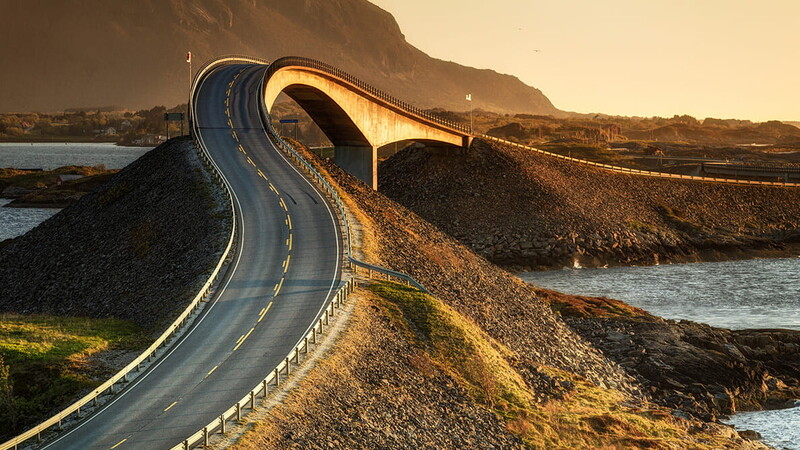
Setting off from Kristiansund, better known as "the city of dried cod", and crossing the Storseisundet bridge, one reaches Molde, a small town enjoying a beautiful panorama over of the peaks on the Southern shore of the fjord. The place is known as the "city of roses" due to its mild climate. Here, in fact, roses and other plant species thrive that would be unthinkable to find in other places at the same latitude. It is the fitting reward after experiencing such an adventurous route.
The Atlantic Ocean Road can be travelled by car, by bus or bicycle and, in accessible sections such as the elevated path of Eldhusøya, even on foot. Along the way, the Strømsholmen sea sports centre organises fishing trips, snorkelling with seals or wildlife safaris along the coast. In Håholmen, daily boat trips offer a unique opportunity to encounter local marine fauna. Last but not least, birdwatching is another popular activity, as Norway boasts hundreds of species, from majestic white-tailed eagles to charming puffins.