In brief: the golden rules
1. Observe the road before feeling it: shiny tarmac, wet patches, gravel, manhole covers and road markings are warning signs.
2. In the first few kilometres, you need to “test” the grip on a straight, with progressive braking and acceleration.
3. You must not find the limit, but sense where it is in order to know how much margin remains.
4. Brake early, progressively and, where possible, with the motorbike upright.
5. In a bend, grip is not tested, it is respected: wide, rounded lines, gradual entry and a gentle throttle on exit.
Everything passes through two contact patches on the ground
The motorbike runs on the two small contact patches of the tyres: braking, accelerating and cornering — everything passes through there, through the grip available at that moment.
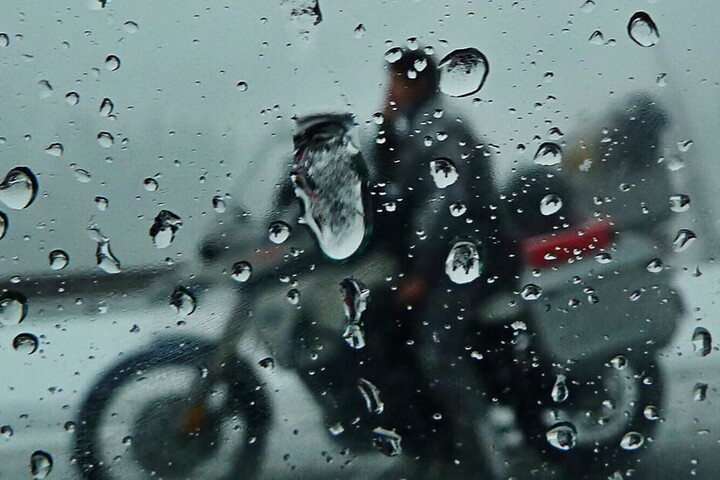
Grip varies enormously. In competitions grip is the ultimate testing ground, and the lean angles achieved are impressive, whereas on a sheet of ice it drops close to zero. On the road, you travel between these two extremes, and when the tarmac is slippery due to cold, dirt or rain, in addition to riding with great care, you need to have a perception of the available grip.
How to recognise treacherous tarmac
The first thing is to observe. A critical road surface may be:
• shiny, damaged or wet;
• dirty, with gravel deposited at the edges of the carriageway;
• with hazardous elements: road markings, manhole covers, patches.
If the tarmac is wet, grip can be noticeably reduced and, above all, become less uniform; cold makes the situation worse. So how can you tell how much grip the tyre has? There are several signs that can help you assess it.
How to assess grip without approaching the limit
In the first few kilometres, or when conditions change, you need to build up a picture of the available grip. The safest way to test grip is on a straight. By braking and accelerating progressively, you should observe:
• the slightest movements of the tyres on the road surface;
• any hints of loss of grip;
• the behaviour of the steering and the response to inputs.
You should not provoke skidding in order to understand how much grip is available: it is enough to gather information on the behaviour of the motorbike and always maintain a good margin.
If the motorbike is equipped with electronics, the triggering of traction control and ABS provides valuable indications: if they activate frequently, it means that a great deal is being asked of the tyres in regards to the available grip.
Ride with delicacy: separate the demands
In slippery road conditions, you need to ride in a way that minimises critical actions. A moderate pace must be combined with a light and progressive hand on the controls. It is like playing the violin: every movement must be precise and measured in relation to the others.
The reason is simple: the tyre provides a certain amount of grip, and when some of it is used for one function, less remains for the others. With abundant grip, actions can be overlapped — for example, entering a corner with the brakes lightly applied or accelerating with the motorbike at a good lean angle. When grip is scarce, however, it is better to ask the tyre for one thing at a time: braking; turning in; cornering; exiting the corner by coordinating the acceleration with the reduction of lean angle. A certain overlap of actions is inevitable, but it must be well calibrated.
Riding in various situations
When grip is limited, the most critical moments are changes in speed and lean angles. The safest situation is to travel along a straight at a constant speed (barring unexpected hazards such as a sheet of ice or a deep pothole), while every manoeuvre must be executed with care.
Braking: prepare, then brake
The key word is progressiveness. You start with very light pressure on the controls and increase it gently up to the level perceived as safe, which leaves a good margin before the point of skidding. No sudden grabs.
Here are the general rules:
• increase the distances from other vehicles;
• anticipate braking to reduce the need to brake hard;
• wherever possible, carry out the most important part of braking with the bike upright.
The best technique is to use both brakes together. The rear contributes to deceleration and can help keep the bike composed; the front does the main part of the work, as the greater load increases tyre grip and allows more braking force to be developed.
Today, most motorbikes are fitted with ABS, which intervenes when it detects a tendency for a wheel to lock, automatically modulating braking pressure.
If there is no ABS and a wheel tends to lock, you need to immediately reduce the pressure on the relevant control: when the tyre recovers grip, increase it again progressively.
In corners: grip is not tested, it is respected
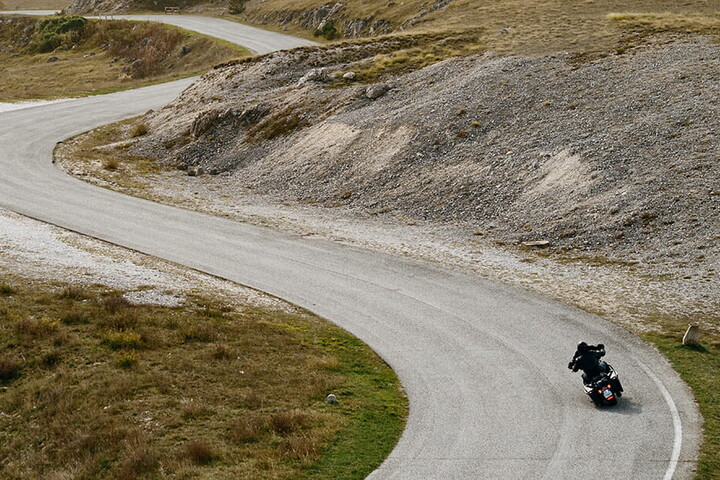
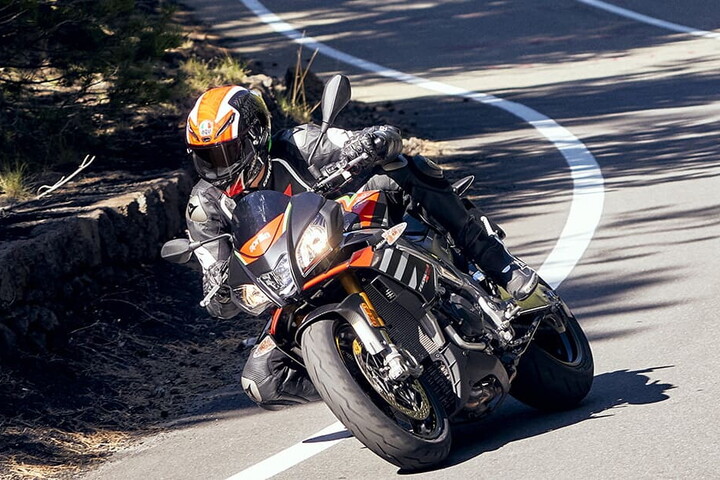
The most critical condition on roads with low grip is the corner. If lean is increased beyond the limit, the tyres can lose grip and a fall becomes very likely: on slippery tarmac, when a tyre “lets go”, it is very difficult to recover it. Here too, progressiveness applies:
1. gentle braking and release of the brakes;
2. gradual entry into the corner;
3. wide, rounded line;
4. exit with gentle acceleration.
It must not become a rigid, textbook sequence: the various actions must follow one another in a fluid and precise manner, to avoid having to correct the line mid-corner, brake sharply, or close or reopen the throttle.
An experienced motorcyclist can perceive grip even when leaning over, through the body, the footpegs, and above all the handlebars. It is a sensitivity that is acquired over time, by getting used to listening to the motorbike in every situation.
In acceleration: caress the throttle
Even accelerating in a straight line with little grip requires attention, but it is not the most critical condition. As soon as the rear is felt to be spinning, to avoid skidding you need to progressively reduce the throttle opening until the tyre regains traction. At that point, acceleration can be resumed, always with a moderate throttle opening.
In a corner, the situation changes. A large part of the grip is used to keep the motorbike leaned over, and you accelerate excessively the rear can lose grip and trigger a slide that is difficult to control. Traction control significantly reduces the risks.
The most advanced electronics
ABS can have multiple intervention levels: ranging from the sporting setting to the most conservative one, to be used in the most demanding conditions. With an inertial platform, which detects the motorbike's movements moment by moment, the ABS can be of the Cornering type, which modulates braking whilst also taking the dynamics into account. It increases the safety margin, but does not eliminate the physical limits of grip.
Many high-end motorbikes have multiple engine maps to be used according to requirements: the more conservative ones, for touring riding or for rain, set torque delivery in a smoother form, so as to avoid putting the tyre under stress whilst it is working in conditions of limited grip. These too can work with an inertial platform, and regulate the torque delivered depending on the lean angle.
Before setting off: tyres, motorbike and clothing
These topics would each deserve a section of their own; we mention them here to highlight the importance of preparing the rider and the motorbike.
When we take our motorbike out, for a journey but also for a simple trip, the first thing to check are the tyres. You need to check the degree of wear of the tyres and the pressure, which must be that indicated in the owner's and maintenance manual of the motorbike.
Clothing is also important, and must meet two requirements: it must be comfortable and protective. Comfort, which includes protection from the cold and from water, helps us to maintain our energy and concentration whilst riding - factors that are decisive for safety. And protective gear is essential, even for a summer ride.
In conclusion
Riding on slippery tarmac does not mean riding whilst afraid, but rather with caution: observing the road, listening to the motorbike, “testing” the grip safely and asking what you want of the tyre while staying well within the limit, so that there is always still some in reserve when needed.