Interview with Leonardo Fioravanti by Alessandro Cappelli
Photo: Ryan Miller and Tommaso Geraci
Surfing competitions are decided in a matter of a few crucial seconds. The surfer waits for the wave, reads the tide, follows the current, stands on the board and takes off, carving along the face of the wave before disappearing inside a tube of water. It is the spectacular moment; the one captured in photographs and videos. But it does not reveal everything that has taken place beforehand. Behind every wave ridden there are long training sessions, hours spent in the water – waiting, weeks dedicated to physical preparation, injuries and recovery periods. It is the ability to ride that board time and again that shows the surfer as a craftsman of waves. In modern surfing, especially at the highest level, talent is not what makes the difference. What matters is the ability to turn thousands of invisible details into a movement that, from the outside, looks completely natural.
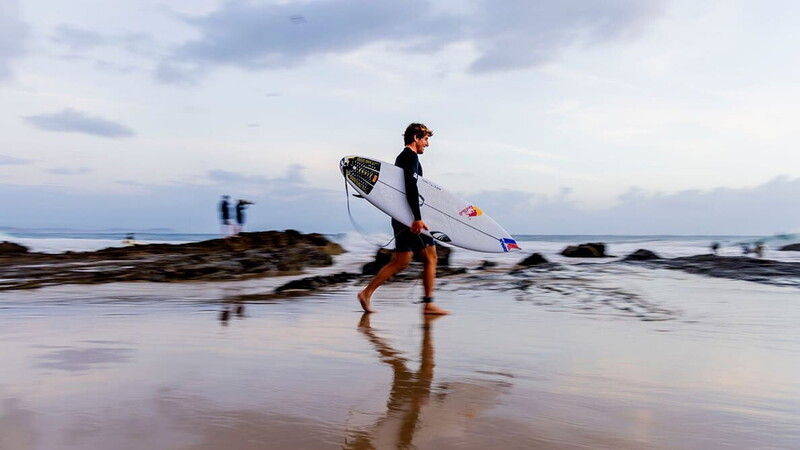
Leonardo Fioravanti is the first Italian to establish himself on the World Surf League Championship Tour and a two-time Olympian. In June 2026 he went one step further by claiming his first tour victory – and Italy's – at the Surf City El Salvador Pro, beating Brazilian Olympic champion and world number one Italo Ferreira. It's another marker in his rewriting of the history of italian surfing.
He often speaks about waves, the ocean and technique. But listening to him, what emerges above all is a quiet form of expertise, built over years, that does not need to be bragged about. “I can say anything,” he says. “That I want to win this or that, but in the end only surfing speaks for me.”
It's an attitude that sums up the emotional journey of someone who reached the top of his sport very early on in life and who, precisely for that reason, had to quickly learn that talent is not enough. “I realised it especially because of an injury when I was 17,” he says. “I was out of the water for six months, had two operations and then did a lot of physiotherapy. That's when I understood I had to fully commit, doing everything properly: nutrition, gym work, recovery, rest. All the things an athlete does, which I didn't really know before then. But today I feel in the best shape of my life.”
It is a rite of passage that is almost inevitable for those who reach the highest level at such a young age. Fioravanti qualified for the world circuit when he was just 18. “When I qualified, I was probably too young,” he says. “You find yourself competing against the best surfers in the world and you take some hard hits from reality. They are not easy to digest.”
When it comes to competitions, surfing becomes more complex than a simple passion. Over the past 10 to 15 years in particular, the world surfing circuit has evolved dramatically, moving towards an unexpected and rapid professionalisation. Surfers are now elite athletes supported by coaches, physios, nutritionists and more. “The kind of athletes we see today didn't really exist [when I started],” adds Fioravanti. “Now, if you're not fully committed to surfing and living like a professional athlete, you might reach the top, but you won't stay there.”
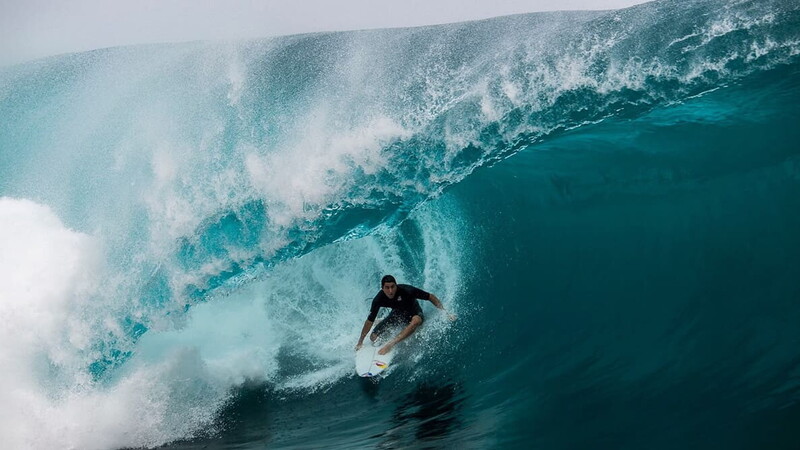
And yet surfing retains an irreplaceable instinctive dimension, one that perhaps cannot be trained. It is a kind of knowledge that every surfer develops gradually, through time spent in the water and through learning to read something that can never be fully controlled. You need instinct that connection with the Ocean that you only develop by spending hours and hours in the water. You have to learn to read the sea,” says Fioravanti.
What is interesting is that, over time, this reading process becomes almost unconscious, according to Fioravanti. “Sometimes, you can feel the current shifting in a certain way; you then understand that you need to move slightly over there. When a big wave comes, you feel the power of the ocean starting to pull you. You follow the currents, you follow instinct. These are details you learn over a lifetime in the water, and at some point you make these decisions without even thinking.”
Even waiting is part of that process. Surfing is a sport of long stretches of silence. A blend of adrenaline and patience, carefully balanced through moments when, on the surface, nothing seems to be happening at all.
The ability to manage pressure is central to Fioravanti's career and something that has developed with time and experience. “Before 2021, talking to a sports psychologist felt very strange,” he says. “Many people suggested it to me and I didn't want to hear about it. Then I started working with a professional and I think it was one of the most important moments of my career. It helped me a lot in the water, but also outside it.”
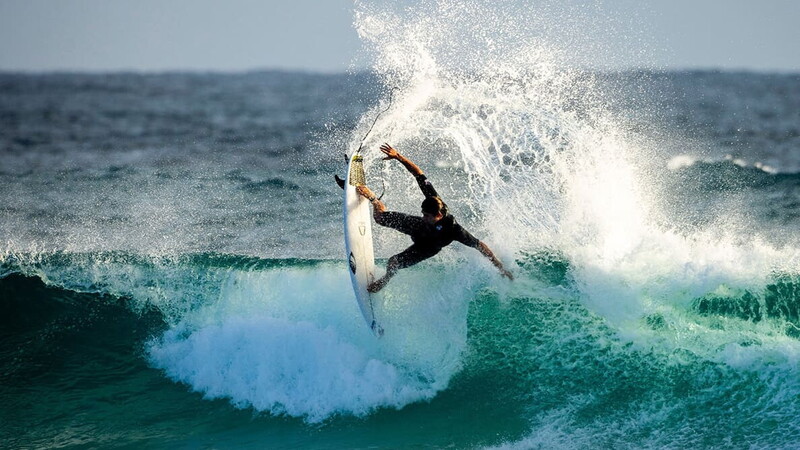
Like many athletes, Fioravanti learns through trial and error. “I've learned more from the waves I got wrong than from the ones I rode well,” he says without hesitation. “When I was younger, I used to get angry much more easily. I was in a hurry to get somewhere. Today I've understood that every mistake teaches you something. As long as you recognise it and don't keep going over it mentally – you also have to let it go and move forward.”
It is an approach that reflects a broader vision of surfing: a discipline in which total control simply does not exist. The ocean cannot be dominated. It can only be interpreted, by each in their own way. This is because surfing does not lend itself to uniform styles, even in an era where everything seems measurable.
“Style is very important to me. Perhaps even too important,” Fioravanti says frankly. “The good thing is that everyone has their own. There are very strong surfers whose style I might not like, but technically they do incredible things. I think I have an elegant, fluid style and I'm proud of that. In terms of scoring, [style is] not the most important thing, because judges look at other factors. But for me, it matters.”
For Fioravanti, it is a constant search for perfection, yes, but always expressed through a personal and recognisable form: a personal signature left on each wave.