Interview with Eugenio Amos by Gabriele Ferraresi
Photo: Filippo Tarentini - Art direction: Elena Papageorghiou - Photo assistant: Andrea Ceppi
Anyone who has driven a car knows what it feels like to face a bump in the road: the instinctive reaction is to brake and slow down before your tyres reach the obstacle. But in a racing car on a dirt road, instinct can be your first mistake. “If you brake on a bump, you'll wreck the car,” says Eugenio Amos. “If, instead, you have the presence of mind to accelerate, you'll end up with less damage than if you brake.” The same principle applies to a sudden hole in your path. “If, at the last moment, you're facing a hole, you often have to go straight [over it]. It's counterintuitive, but that's how it is.”
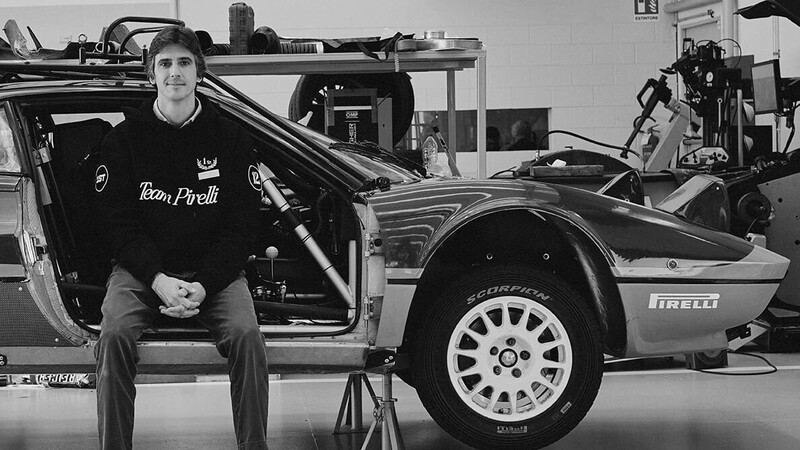
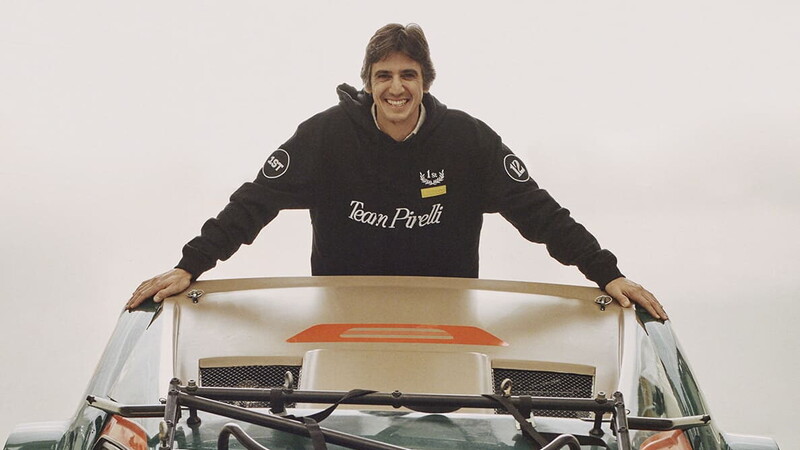
Amos, 41, lives in Varese in northern Italy and wears many hats: entrepreneur, racing driver, car collector and founder of Automobili Amos. He gained recognition in the automotive world with the Delta Futurista, a contemporary reinterpretation of the Lancia Delta Integrale, followed by the Safarista, a more radical, racing-oriented evolution. In recent years, he has also been busy with GTO Motors, a company specialising in classic and modern Ferraris, combining restoration, workshop work and a deep passion for mechanical culture. Yet, when asked to introduce himself, Amos doesn't start with his projects: “I'm a father of two amazing children and they get most of my energy and attention. I'm an entrepreneur in my spare time, but only when I'm not busy being a dad.”
Amos belongs to a rarefied world where a car can be many things at once: an aesthetic object, a technical achievement, a family memory, a privilege, a private obsession and a sporting challenge. Reducing Amos to a passionate collector would be an oversimplification: his work involves financial investment, but that alone explains nothing. Money can buy a car, but it cannot necessarily give it meaning. It can finance a project, but it cannot replace taste, culture, judgment and skill – qualities that Amos possesses in abundance.
That remark about the bump reveals much about the way he approaches driving and perhaps also offers a glimpse of how he navigates the world. It is far from pure speed, showmanship or heroics. It is a form of knowledge that emerges at the exact moment when your body wants to act one way, but experience dictates another. The right move is not always the one that appears most cautious. Sometimes braking is the mistake and accelerating is control.
The Delta Futurista, the project that first brought Amos to prominence, was already rooted in this territory. Yet Amos rejects the idea that he created an icon. “To claim that would be disrespectful to those who came before me, and to the Delta itself. I worked on something that was already an icon. I simply tried to offer my own interpretation of it.” In a different way, the same thing happened when he decided to bring another shape, deeply etched
into the collective imagination, back into competition: the Ferrari 308. “To me, an icon is something everyone knows, even people who aren't car enthusiasts. Mention Magnum, P.I. and they think of the 308. Mention a Delta in Martini livery and people recognise it immediately.” For Amos, the point is often – though not always, as demonstrated by the Tuono, an extraordinarily unconventional hatchback designed by Automobili Amos in 2020 that never reached production – to intervene on objects that already exist in the collective memory. Cars that embody forms, memories, proportions, colours and sounds, and that continue to mean something even to people who wouldn't know a carburettor from a differential.
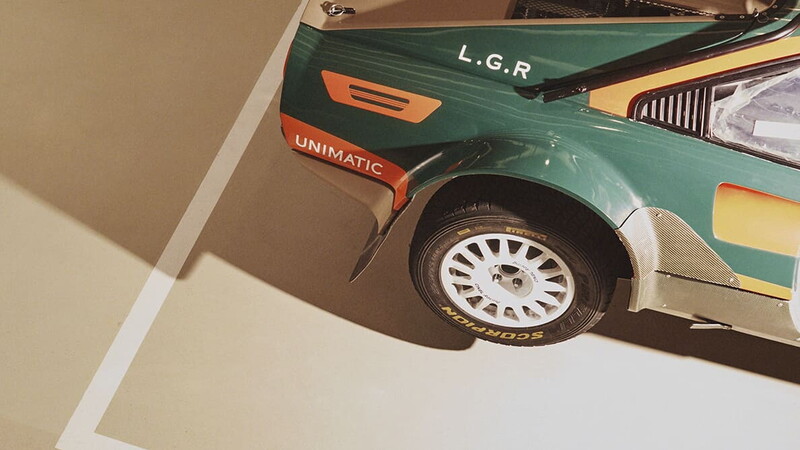
Having already won the 2023 East African Safari Classic Rally with a Porsche 911 entered by Team Tuthill, Amos could easily have stayed with a proven formula. In that world, and in that kind of competition, a Porsche is almost a guarantee. Choosing instead to prepare a Group 4 Ferrari 308 for the 2025 edition of the biennial rally – more than 3,000 kilometres of red dirt roads across Kenya, through special stages, open roads, heat, dust, rocks, villages, wildlife and local traffic – meant embracing risk for the sake of challenge and beauty, but also climbing aboard something that seemed almost impossible to justify in the middle of Africa. It meant taking a Ferrari 308 as far as possible from the place where most people would expect to find one, forcing it to confront a rally in which those magnificent, timeless lines as drawn by Leonardo Fioravanti were, on their own, utterly useless. Or maybe not? Perhaps that is precisely what makes the whole thing so much more interesting to Amos – even though his car ended up retiring. “On paper, looking at the numbers, the Ferrari should have been the better car. The problem is that paper and reality are two very different things. My idea was to build a car that wasn't just fast, but also sexy. I wanted a beautiful car – something the local people would enjoy seeing and that would bring a smile to enthusiasts' faces. With Ferrari, I sensed something far more romantic, more compelling. Because what I feel is missing today, more than anything else, is romance.”
For Amos, romance means many things, but nostalgia is not one of them. It is not a longing for some vaguely better past, nor a pose adopted in opposition to the present. Rather, it is an attempt to preserve a dimension of the automobile that contemporary culture increasingly tends to erase: its ability to be a form of material culture, not merely a means of mobility; an adventure, not merely a performance machine.
Within this vision, technology does not disappear. On the contrary, it becomes the mechanism through which romance avoids turning into wishful thinking. “The 308 carries all its weight at the rear: gearbox, engine, differential. But up front there's a 107-litre fuel tank, so you have more than 100 kilos loaded over the front axle and that gives the car a certain balance.”
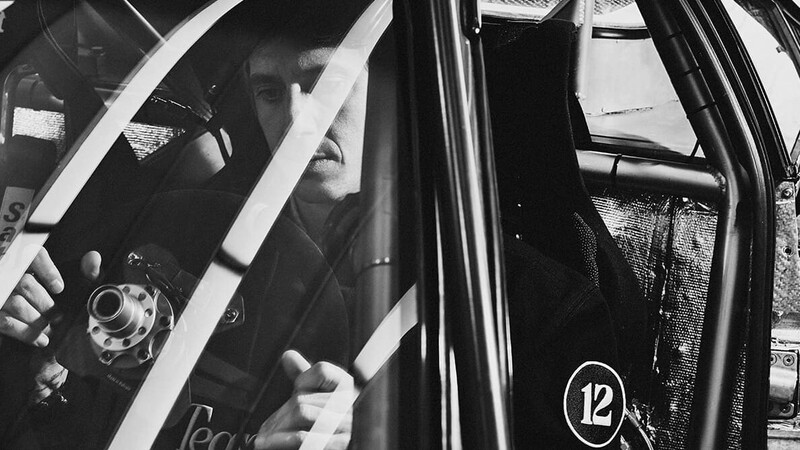
Alongside Amos was co-driver Paolo Ceci, whom he affectionately calls “my racing wife”. The expression says a great deal about the level of trust involved. “Having a good navigator makes an enormous difference, especially when it comes to assessing danger and finding the right rhythm.”
Yet once again, the heart of the story is not competition alone. After years on the track, Amos gravitated towards cross-country rallying while also pursuing the myth of the Dakar Rally – a race his father had contested in a truck and that he himself had followed as a child through the North African stages from the passenger seat of a Land Rover 110. “For me, the travel aspect – the opportunity to visit places, encounter different cultures and have meaningful experiences – is fundamental. It's very different from driving around the same circuit for three days...”
Kenya, Amos says, is also about children, elders, villages, boda bodas (the local motorcycle taxis), as well as colours, smells and human encounters. “It's an emotion that goes beyond competition. For me, these elements are vital.”
At a time when the automobile seems destined to become a device increasingly resembling a smartphone, Amos focuses on what risks being lost: the beauty that makes children smile when an unfamiliar car drives by; the engineering that can still stir emotions; the physical relationship between driver, machine and road. It is neither nostalgia nor a rejection of the present.
It is an attempt to keep alive a culture of the automobile as a physical, aesthetic and moral experience – and as an adventure.