Summer: time for travel, the sea, and motorcycles. Riding along a great coastal road, where every bend opens up a new horizon, offering powerful emotions. Below are five of the most spectacular itineraries in the world, from the Amalfi Coast to California Highway 1, from the Grande Corniche to the Great Ocean Road and all the way to the Norwegian Atlantic Ocean Road. Roads that, as well as representing a dream destination for every motorcyclist, have also captured the imagination of the big screen, becoming the backdrop for chases, adventures, and films that have gone down in history. One more reason to set off, start the engine, and experience a journey as the genuine star, bend after bend.
Amalfi Coast (Italy)
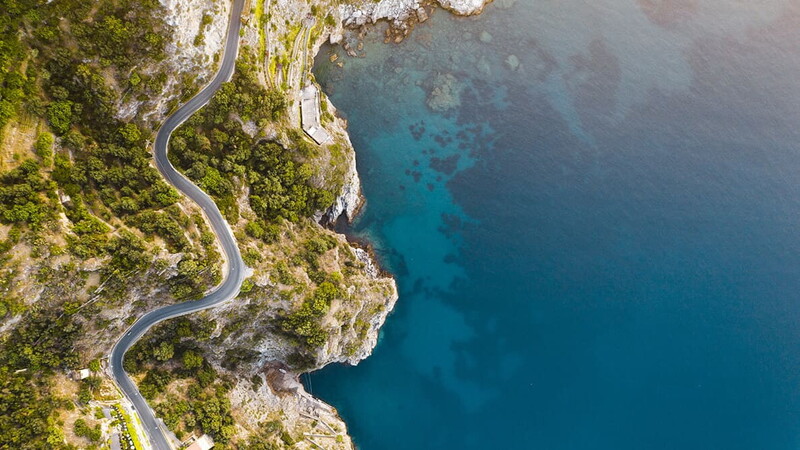
The area is particularly captivating, so much so that a more ambitious tour can begin in Naples, a city that deserves a thorough visit in its own right. From here, the route takes in the archaeological sites at the foot of Vesuvius, among which Pompeii stands out as one of the most important and best-preserved in the world. Continuing along the SS145, you reach Sorrento, which can be considered the starting point of our adventure along one of the most fascinating coastal roads in the world: its characteristics and the beauty of its villages led to the recognition of the Amalfi Coast as a UNESCO World Heritage Site.
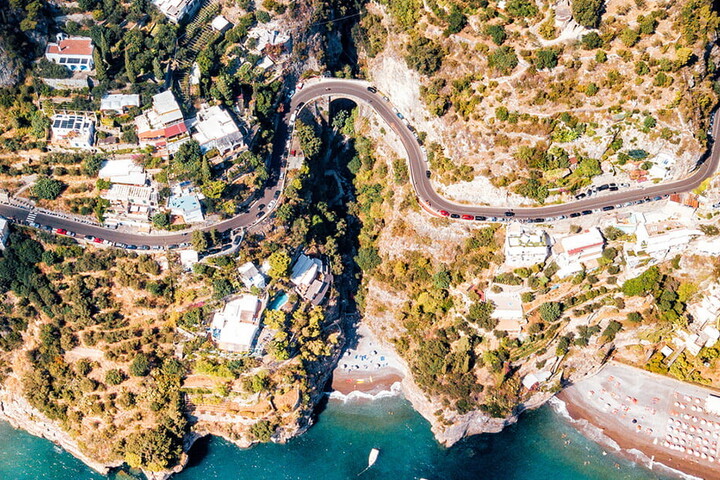
The road is the SS163, with the most famous and scenic stretch running between Positano and Vietri sul Mare: approximately 50 km winding between the rocky face of the Monti Lattari on one side and the deep blue of the Tyrrhenian Sea on the other. A succession of bends, hairpins, and changes of direction that seem designed for those who love travelling by motorcycle.
Riding, however, demands attention, as the carriageway is narrow and is very busy in summer. The road looks out continuously over the sea, offering spectacular views at every bend, and for this reason it is best regarded as a scenic rather than a sporting ride. Not least because along the route, stops in the enchanting villages overlooking the gulf are a must: Positano, which appears suddenly with its pastel-coloured houses; Amalfi, which gives the Coast its name, celebrated for having been one of the four Maritime Republics, and striking for its unmistakable profile and its magnificent Cathedral; Ravello, which is nonetheless worth a small detour from the main route to enjoy a breathtaking view from above.
The film: The Equalizer 3
It is no surprise that the Amalfi Coast has been chosen as a film set for numerous international productions. Among the most notable films, The Equalizer 3 (2023) must be mentioned, starring Denzel Washington, which was filmed largely on the Amalfi Coast, among Amalfi, Atrani, Minori and Ravello. The spectacular roads suspended between sea and mountain and the characteristic coastal villages serve as the backdrop for numerous scenes in the film.
California Highway 1 (United States)
California Highway 1 is endless: 655 miles (more than 1,000 km) largely traced along the edge of the Pacific Ocean, from Dana Point, south of Los Angeles, to Leggett, in the land of giant sequoias, in the north of the State. On a motorcycle, it takes two or three days to ride the whole route, depending on the pace one wishes to keep and any stops at the main coastal resorts of southern California: Newport Beach, Huntington Beach, Long Beach, all the way to Santa Monica and Malibu.
The CA-1 is captivating because it runs almost constantly close to the Pacific Ocean, with endless stretches where towering cliffs, long crystal-clear beaches, megalopolises and small harbours alternate, the images of California's maritime soul.
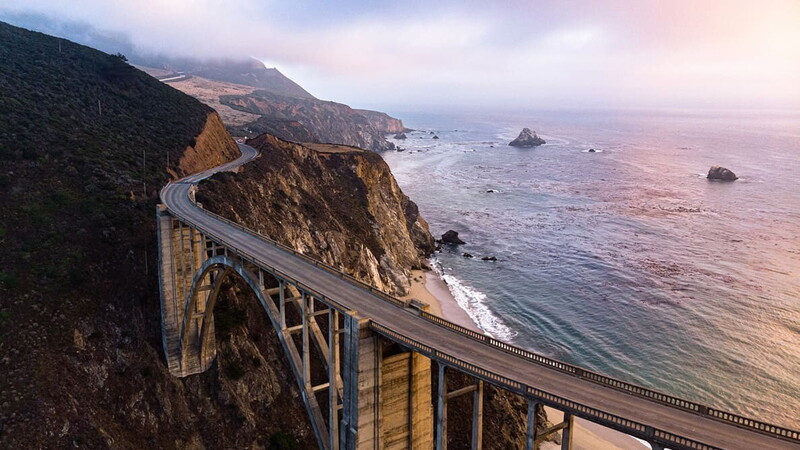
The most spectacular stretch, and also the best known, is Big Sur (the Great South): 150 kilometres linking Ragged Point and Carmel. It is the most technical stretch of the entire route. Building it required a long and complex undertaking, to suspend the ribbon of tarmac between the immensity of the Ocean and the steep Santa Lucia mountains. The bends follow one another with a natural rhythm, alternating quick changes of direction with long sweeping panoramic curves, but a relaxed riding style is always recommended, to savour the splendid scenery between the sea, which crashes tens of metres below, and the slopes covered in the typical vegetation of the Californian coast, oaks, pines and chaparral. Every bend reveals a view, and making the journey even more enjoyable are the numerous viewpoints where it is possible to stop safely to admire the Pacific, to photograph the famous Bixby Creek Bridge, the bridge that is the symbol of Big Sur; crossing it is one of the most iconic moments of the entire journey.
The film: Basic Instinct
California Highway 1 has also entered the collective imagination thanks to Basic Instinct. Right here, in the area south of San Francisco, the famous chase scene was filmed, with Sharon Stone at the wheel of a Lotus Esprit, leaving Michael Douglas behind on a winding stretch of the Highway.
Grande Corniche (France)
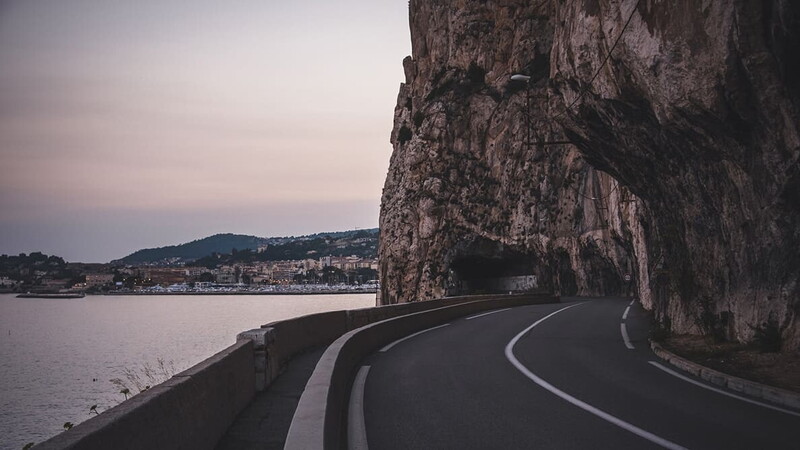
The Grande Corniche links Nice to Menton and is just over 30 kilometres long, yet it concentrates all the elements beloved by motorcyclists. The road is a succession of wide bends, hairpin turns, and stretches that are at times technical and demanding or faster and more flowing, with the road surface always in excellent condition — qualities that invite a brilliant, precise, and rewarding riding style. Always maintaining a pace appropriate for road riding and keeping an eye on safety and road regulations.
Then there is the landscape, offered by the route that alternates rock faces, pine forests, and sudden natural terraces overlooking the sea.
Unlike many coastal roads, the Grande Corniche does not follow the sea at water level, but looks down upon it from above. A privileged position that allows you to take in the entire design of the Côte d'Azur in a single glance, with its inlets, headlands, and the Mediterranean fading away on the horizon. The most spectacular stretch is the one that winds at altitude along the Maritime Alps, rising to over 500 metres above sea level. From here the view encompasses the entire Côte d'Azur and looks down over the Principality of Monaco, with its famous harbour and its yachts, which contribute to the exclusive charm of the Principality.
The Grande Corniche is a road that can also be savoured at a leisurely pace, choosing a calm rhythm and a fluid riding style, to enjoy the continuous succession of spectacular views. It is no coincidence that it has been chosen as the setting for numerous films and advertising campaigns, becoming one of the most iconic coastal routes in Europe.
The film: To Catch a Thief
In the film To Catch a Thief (1955), Alfred Hitchcock transformed the Côte d'Azur into an elegant setting of luxury, mystery and seduction. Cary Grant and Grace Kelly move between villas, hotels, and scenic roads overlooking the Mediterranean, with the Grande Corniche as the protagonist of a famous car chase right above Monaco.
Great Ocean Road (Australia)
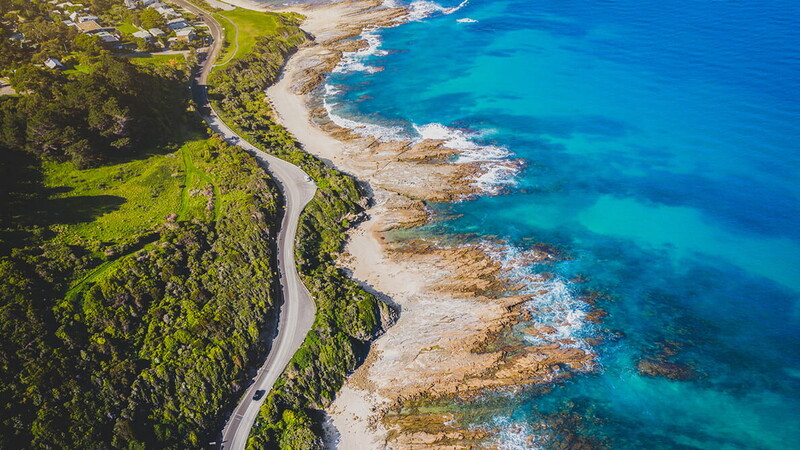
The Great Ocean Road is an extraordinary coastal road that follows the southern area of the State of Victoria for 250 kilometres, connecting Torquay to Allansford. It is distinguished by the wild nature that dominates the landscape: on one side there is the turbulent Southern Ocean; on the other there are eucalyptus forests, hills, and rock faces sculpted by the wind.
The ride is varied and stimulating due to the alternation of situations, with long sweeping bends that follow the coastal profile alternating with more technical stretches and brief undulations; moreover, the road surface in excellent condition invites a fluid and brilliant pace.
The most thrilling stretch is that of Port Campbell National Park, where the road gains height along the cliffs, offering breathtaking views of the famous Twelve Apostles, the imposing limestone stacks that rise from the ocean, splitting the waves. Continuing on, further natural wonders are encountered: the Loch Ard Gorge, a natural gorge with a small beach enclosed between high rock faces; the London Arch, a limestone arch standing alone in the ocean; The Grotto, a natural cavity that frames the sea, forming an open window onto the Ocean.
Riding the Great Ocean Road gives you the feeling of travelling at the edge of the world, on account of the force of wild nature, the whistle of the wind coming in from the Ocean, the scent of the eucalyptus trees, and the continuous alternation of sea, cliffs and forests — elements that make every kilometre different from the last. For this reason, although it flows well, it does not invite you to rush, but to stop at the numerous viewpoints and scenic car parks that are easily accessible.
The film: Point Break
The 2015 Point Break is the remake of the classic film with Keanu Reeves and Patrick Swayze. But the roles do not change: it is the story of FBI agent Johnny Utah, infiltrated into a gang of extreme athletes suspected of a series of spectacular international heists. Between surfing, climbing, snowboarding, wingsuit flying and motorcycling, the film is a succession of action scenes, with the most striking ones set among the cliffs of the Australian Great Ocean Road.
Atlantic Ocean Road (Norway)
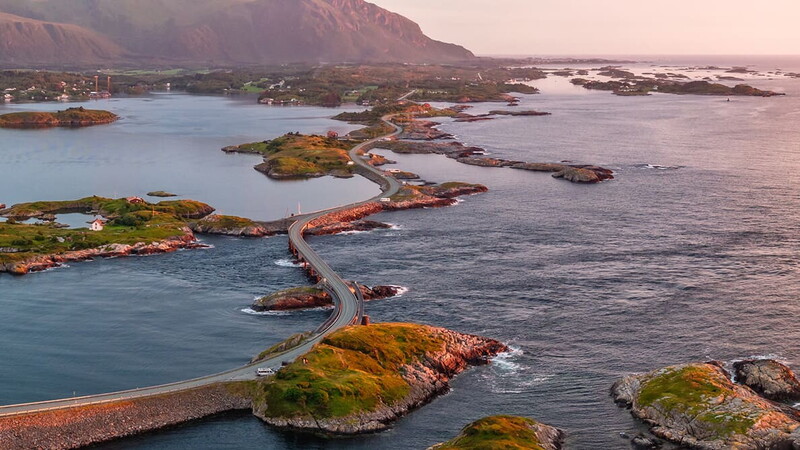
The Atlantic Ocean Road (Atlanterhavsveien) is not the classic road of bends and hairpins that inspires sporting riding; its charm is born from the continual encounter between the tarmac and the Ocean. The route is not demanding in terms of length: the entire scenic itinerary, from Kårvåg to Bud, is 36 kilometres long, and the most celebrated stretch, which connects a series of small islands with eight bridges that seem to float on the sea, is just over 8 kilometres long, but delivers a unique experience. You travel with the horizon almost always open, because there are no mountains accompanying the road: to the right and to the left there is always and only the sea, into which the ribbon of tarmac plunges before re-emerging and pointing towards the sky, in a sort of exhilarating toboggan run.
The symbol of the Atlantic Ocean Road is the Storseisundet bridge, which is approached with a climb so steep that the road seems to disappear into the sky. Riding it on a motorcycle the sensation is amplified, as approaching the summit gives the impression of launching oneself into thin air, but after cresting the top the apprehension fades in the face of the beauty of the ocean that suddenly opens up before your eyes.
On clear days everything is calm and the deep sea reflects the sky, but when bad weather arrives the Atlantic Ocean Road changes its face entirely, becoming dangerous for motorcycles because the highest waves crash against the bridges and the crosswind sweeps violently across the road. Also for this reason it is one of the most photographed spots in Norway, and it has become famous throughout the world for having been chosen as a set for films and automotive and motorcycling commercials.
The film: No Time to Die
In the latest James Bond, Daniel Craig rides along the Atlantic Ocean Road, and no Bond film would be complete without a shot of the Storseisundet bridge. Bond then leaves the tarmac road to make his escape along unpaved tracks, pursued by cars, helicopters and off-road motorcycles.