With asphalt reaching increasingly high temperatures during the summer, designing a summer tyre today is a very different challenge compared to the past. Climate change dictates compounds capable of resisting heat without losing performance, but the scenario is further complicated by regulations on emissions and the reduction of fuel consumption.
A matter of balance
“Today the market demands tyres that last longer, consume less, and have low rolling resistance”, explains Eros Fumagalli, a Pirelli test driver. “From a chemical perspective, this pushes us towards 'cooler' compounds. But at the same time, temperatures are rising and the asphalt is becoming more critical. If you make a tyre that lasts 60,000 kilometres but cannot withstand the heat, it is useless”. “It is easy to make a tyre that goes very fast at the Nürburgring”, they say at Pirelli. “You simply push the compound. The problem is that you then exceed limits on consumption and rolling resistance, and that product will not even achieve type approval”. The work therefore becomes a matter of balance: grip, durability, consumption, and safety. All together.
The legacy of Formula 1
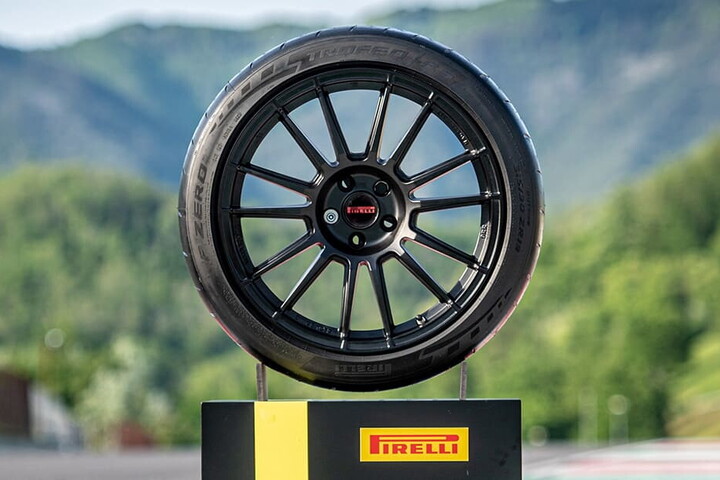
Behind many high-performance summer tyres is a DNA born on the track. Formula 1, like motorsport in general, is Pirelli's great laboratory. “The virtualisation we use today comes directly from motorsport,” explains Fumagalli. “There, every simulation is a matter of tenths of a second. This know-how, this way of working, has now passed into road production”. An emblematic case is that of the Pirelli P Zero Trofeo RS, a tyre explicitly derived from racing experience. “We say it openly: from race to road”, he says. “These are tyres for the road, but conceived on the track. They are born there and then adapted for real-world use”. However, the transition is not automatic. “In motorsport, economic compromises do not exist. You don't look at costs; you only look at performance. We, instead, must industrialise the technology: make it producible, reliable, and accessible”. This is the bridge between the track and the road, transforming an extreme solution into a product for everyday use.
There is no such thing as a “neutral” tyre
Behind every tyre is a design direction that guides its behaviour. “Our test drivers do not just measure numbers: they interpret the tyre”, he explains. “And this is our identity. Anyone driving on Pirelli knows what to expect, just as when you get into a car and recognise “'that' specific type of handling”. For this reason, Pirelli invests resources in the training of test drivers: years of training, cross-referencing tests, and blind testing. “The test driver does not avoid the problem: they look for it. They push the car to the limit to understand what happens when you lose grip. It is a completely different job to that of a racing driver”. And this is where the product's signature is born: a Pirelli summer tyre is not just a compound and a design.