By Hannah Strange
“This is the dog,
That worried the cat,
That chased the rat,
That ate the malt
That lay in the house that Jack built.”
In this well-known English nursery rhyme, Jack, the protagonist, is not on a traditional linear journey, but instead at the centre of a cumulative, layered narrative that ripples outwards around him, exploring the interconnected relationships between everything and everyone in the surrounding environment.
It is this concept that lies at the heart of The House That Jack Built, the most extensive retrospective of architectural works and spatial research by Rirkrit Tiravanija, showing at Pirelli HangarBicocca in Milan. One of the most renowned figures on the contemporary art scene, in particular in the arena of relational aesthetics, the Thai artist has long dedicated himself to people, participation and the social experience as his primary medium. With this exhibition, he invites visitors into a world of constantly shifting relationships, designed to spark the imagination and encourage them to see architecture through a different lens.
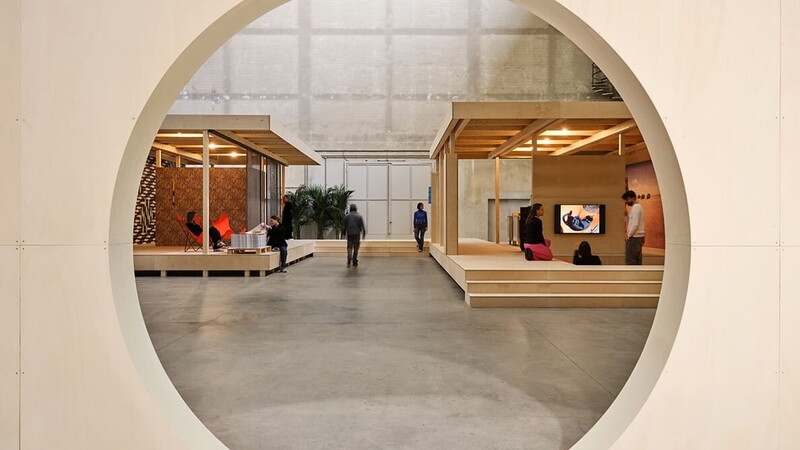
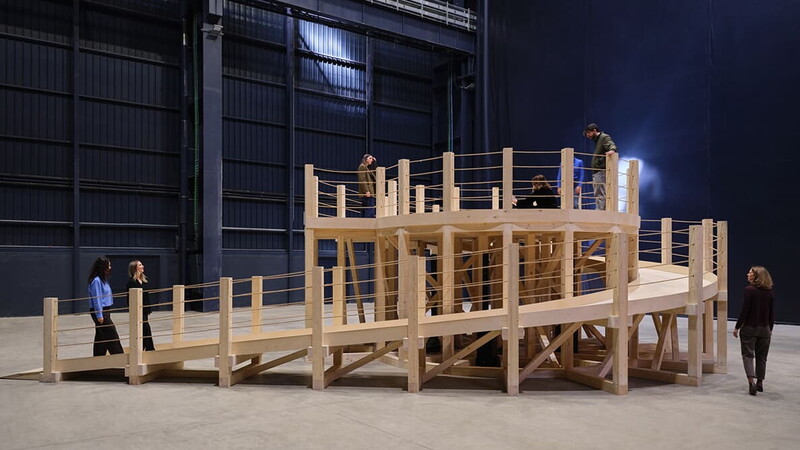
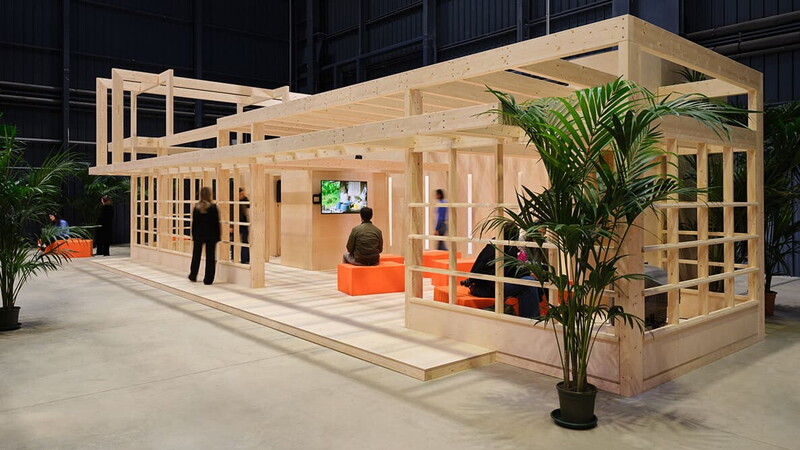
Entering the vast space of the venue's Navate, the visitor is immediately pulled into a maze that forms the backbone of the exhibition. Made from orange fabric evocative of Buddhist robes, the maze winds through 10 installations that draw on major works of architecture, but reimagine them as frameworks for social relationships and encounters. The maze guides visitors along a path directed by the artist, but which they must navigate, allowing for the installations to be discovered and experienced from different angles and perspectives.
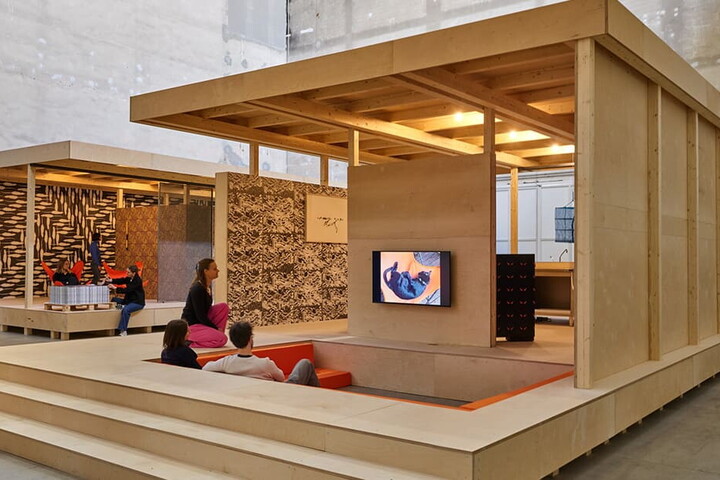
Inspired by modernist figures including Philip Johnson, Rudolf Michael Schindler, Friedrich Kiesler, Le Corbusier, Jean Prouvé, Carlo Scarpa and Sigurd Lewerentz, these architectural structures are conceived not as display objects, but as participatory environments, brought to life by how people use them and the shared experiences that take place within them. As Tiravanija says in a conversation with exhibition curators Vicente Todolí and Lucia Aspesi, his interest is never purely the object or structure itself, but the human activity around it – how people gather, cook, inhabit, improvise and create memories. For him, that is how a building gains true meaning: “The way people actually use it is completely different from what the architect originally intended. And I think that's the beauty of it: people take it over and insert themselves into it.”
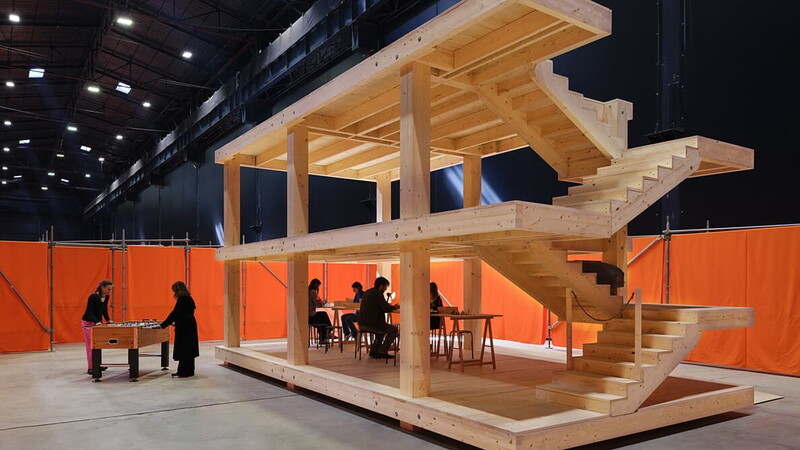
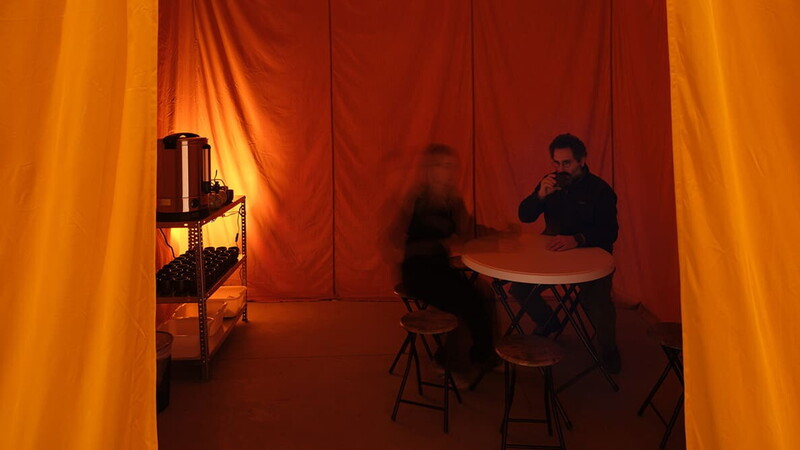
With that social dimension in mind, activations are deeply embedded within the exhibition, encouraging visitors to participate, engage in conversation and embrace spontaneous encounters. For example, untitled 1998 (dom-ino) (2026) – a reinterpretation of Le Corbusier's Dom-ino House of 1914, originally conceived as a model for standardised social housing – is transformed by Tiravanija into a place of gathering and interaction, through board games, card games, even table football. Meanwhile untitled 1992 (cure) comprises a tent made of orange fabric hung from the ceiling, in which the visitor finds a small table, camping stools, a hotplate, kettles and a variety of teas – an intimate setting which lends itself both to seclusion and conversation.
These activations have been developed in collaboration with groups from across Milan, an undertaking that itself builds connections and invites the wider urban and social surroundings into the museum. As Tiravanija seeks to transform and bring meaning to architectural spaces through movement, people and unpredictability, so too is the museum transformed, from an institution offering a traditional viewing experience into a space in which to spend time, create memories and interact with people who might otherwise not encounter each other.
Ultimately, Tiravanija hopes that visitors will leave the exhibition with a sense of themselves. “I like for them to come with what they come with and then experiencing the possibility that they could extend themselves a bit – to step over certain lines that they would never step or do certain things that they would never do or meet other people that they would never meet.
“In a sense, it's really kind of about encountering, going through the maze and finding yourself in a place, maybe with some other people, and then having a kind of experience with that and then going away, realising your sense of self. Because in the end, to be able to live with others and otherness is important probably more to understand yourself better.”
Q&A with Vicente Todolí, Artistic Director of Pirelli HangarBicocca and co-curator of the exhibition
HS What made this the right collaboration for Pirelli HangarBicocca as an exhibition space; what excited you about it as curators and were there any particular challenges or opportunities it presented?
VT Pirelli HangarBicocca was the ideal context for this exhibition because the scale and openness of the Navate and the Cubo allowed us to fully develop the part of Tiravanija's practice devoted to the architectural dimension, transforming the exhibition into an immersive sequence of environments rather than a conventional retrospective.
As curators, Lucia Aspesi and I really endorsed Tiravanija's intuition of constructing a journey through space, where visitors move between moments of collectivity and intimacy. One of the main challenges was balancing the monumental scale of the space with the intimate and participatory nature of many works, but this ultimately became an opportunity to create a dynamic and layered experience for visitors.
HS How does this exhibition seek to challenge the idea of a museum as a traditional institution, ‘a mausoleum of emblematic works' and instead reposition it as a social space?
VT Although The House That Jack Built is conceived as a retrospective, we approached it as an evolving and site-responsive project rather than a fixed historical survey. As with previous exhibitions at Pirelli HangarBicocca dedicated to Lucio Fontana, Juan Muñoz or Mario Merz, the intention was to reinterpret the artist's practice through a new spatial and conceptual framework specific to the institution. In Tiravanija's case, this meant creating an exhibition that continuously shifts between artwork, architecture and lived experience. The show unfolds through changing uses of space, allowing the exhibition itself to remain open and shaped over time by those who pass through it.
HS There's a strong emphasis on participation, but also on unpredictability – the idea that “a lot of people” complete the work. Can you give some examples of the moments and interactions you have seen it produce and what has been the most unexpected?
VT One of the most interesting aspects of the exhibition is precisely how differently visitors experience and activate it. Many of the works are designed to be completed through the participation of “a lot of people”, like untitled 2026 (demo station no. 9) (2026), inspired by the Raumbühne (1924), the stage-like structure by the architect Friedrich Kiesler, where activities developed in collaboration with Milanese organisations and community groups are regularly hosted and open to everyone. Another example is untitled 1996 (rehearsal studio no. 6, open version), which functions as an open recording studio that visitors can inhabit and use collectively, mimicking the studio in which Tiravanija used to play with his friends in New York.
What has perhaps been most unexpected is how naturally people slow down inside the exhibition – spending time together, talking, resting or simply wandering without a fixed direction. That openness to unpredictability is very much at the core of Tiravanija's practice.
HS The exhibition is deeply connected to ideas of movement, community and shelter – themes that resonate strongly with contemporary global life. Do you see it having a political and/or social message that is relevant to us today?
VT Rather than delivering a direct political statement, the exhibition creates situations that encourage reflection on coexistence, care and shared experience. Ideas of mobility, temporary shelter and collectivity naturally resonate with contemporary conditions of instability and displacement. For Tiravanija, these questions emerge through participation and lived experience: visitors are invited to inhabit the space together, transforming it into a place shaped by interaction and exchange.