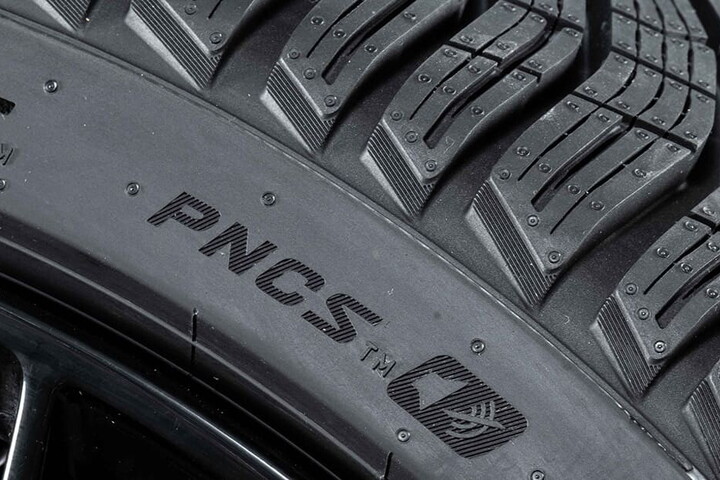
What has disappeared from cars with the arrival of electric vehicles? The engine noise. This absence has left a void now filled by another sound that has always existed but remained unheard: the noise generated by tyre rolling. This is why a technology like PNCS, the Pirelli Noise Cancelling System, has become crucial in this transition phase towards “plug-in” vehicles.From internal cavity resonance to the challenges of materials, adhesives, and production processes, Manuele Redaelli, Head of Premium Product at Pirelli, explains how silence has become the new frontier of innovation.
When noise is no longer masked by the engine
“Historically, this noise has existed as long as the tyre itself: quite simply, it was barely audible”, Redaelli explains. With the arrival of hybrids first and subsequently electric cars, what was previously semi-hidden by the combustion engine has emerged clearly within the cabin. “It is a noise that can be annoying, like a background hum”, he says, referring to the resonance of the tyre's internal cavity, which is now one of the primary sources of noise perceived inside electric cars.
The intuition: addressing the vacuum
The core idea behind the Pirelli Noise Cancelling System was born from this evidence. “If the problem is the volume of air inside the tyre, the solution is to act there”, Redaelli explains. The PNCS utilises a sound-absorbing sponge applied to the inside of the tyre, with a minimal weight of approximately 200 grammes. “The sponge interrupts the air flow and dampens the vibration, functioning as a genuine acoustic damper”. Pirelli technology reduces noise by at least 3 decibels within the frequency range affected by cavity noise, providing significant benefits to perceived sound levels.
True technological complexity
Behind a clear benefit for the end customer lies a sophisticated research effort. “There is an entire world behind the sponge materials”, Redaelli highlights. Pirelli collaborates with various suppliers and conducts extensive tests not only on the sound-absorbing materials but also on the adhesives used for fixing them. “The glue is a fundamental element, as is the preparation of the tyre's internal surface. Since it is a component applied to the finished product, the system must perform identically at extreme temperatures, from the freezing conditions of Alaska to a high-performance car exceeding 300 km/h and the resulting heat”.
No compromise on performance
One of the key points concerns the impact on performance. “From this point of view, there are no compromises”, Redaelli clarifies. PNCS is tailor-made for every application, adapting the size and arrangement of the sponge. “The challenge is to maximise effectiveness without interfering with the rim or the mounting operations”. The objective remains unchanged: “To guarantee the typical performance of a Pirelli tyre, always”. Looking to the future, PNCS is destined to become increasingly central to the development of tyres for electric vehicles. “The technology is mature, but we continue to work on materials and their behaviour under various usage conditions”, Redaelli explains. Every electric vehicle filters vibrations differently, necessitating increasingly targeted development.
Elect: tailor-made technology for electric vehicles
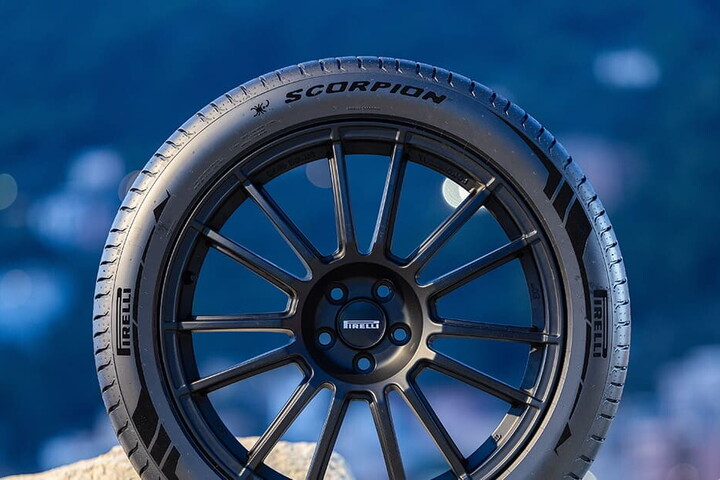
Beyond PNCS, there is another technology designed specifically for electrified vehicles, increasingly adopted by premium and prestige manufacturers: Elect. “Designed to enhance the characteristics of electrified vehicles, it optimises range, silence, and dynamic behaviour”, says Redaelli. He adds that specific compounds allow for the management of the high torque produced by electric motors, combined with reinforced structures to support the weight of the batteries and reduced rolling resistance, which can provide up to 10% more range¹. This specialty is available across the entire Pirelli range, from summer products to winter tyres.
¹Comparison of PIRELLI SCORPION™ ELECT™ and PIRELLI SCORPION™ tyres, size 235/60/R18, measuring the battery range gain resulting from the reduced rolling resistance in the ELECT™ version. The tests were conducted on a Volkswagen ID4 under instrument conditions at a constant speed of 50 km/h for a range of 550 km. Source: Internal Pirelli R&D testing conducted between March and June 2022.