It is considered the hardest in cycling history, achieving legendary status for a combination of factors: the extreme length of the stages, averaging nearly 400 km, for a total of 3,162 km, made even more difficult by the often prohibitive weather and road conditions, which were all unpaved. This led to a huge number of withdrawals - the absolute negative record for the entire history of the race: out of 81 starters, only 8 reached the finish line. And to think, illustrious athletes were among them: Carlo Galetti, Luigi Ganna, Giovanni Gerbi, Giovanni Rossignoli, Lucien Petit-Breton (winner of two Tour de France titles), Costante Girardengo and Alfonso Calzolari…
To understand the importance of this feat, one must be aware of the conditions under which the athletes had to race, starting with a new element for the Giro d'Italia: the stopwatch.
The time trial, a new enemy
Before 1914, the Giro classification was determined simply by finishing position: if you arrived 20th and your rival 21st, you gained a point. It didn't matter if you arrived two hours or two minutes ahead. This was because, given the difficulty and length of the routes, each stage was more like a journey than a race, and time was not considered important: the key was just to finish. While victory at the end of the Giro went to the rider who consistently placed first or in excellent positions, this system offered the possibility of stopping to rest. One only had to keep an eye on rivals, and they, too, were thinking about rest.
With the time trial, however, everything was recorded. Did you lose ten minutes because you had a puncture? You had to make that time up; there was no alternative. Everything became more frenetic, competitive, and average speeds increased. What's more, there was also a time limit, fixed at 4 hours behind the stage winner: exceed that, and you were disqualified.
Assistance? DIY
Today, cyclists have maximum support, but at that time, riders had to perform every repair themselves, even in the middle of a 400 km stage. They were forced to carry tools, inner tubes, and spare parts. In the event of a puncture, the cyclist had to repair it using their own means, and the same applied in the event of a mechanical failure, as replacing the bicycle was not permitted. So, they improvised, seeking help from the public or finding a workshop along the road for makeshift repairs. But everything had to be done solo, or face disqualification.
Inflexible rules world-wide
During the 1913 Tour de France, on the legendary Col du Tourmalet, Eugène Christophe broke his fork due to the rough ground. To find a repair shop, he carried his bicycle on his shoulder for 14 kilometres, and then repaired it personally, as per the rules. However, he received a 10-minute penalty for “external assistance”: a local boy blew on the bellows of the forge fire for him. In total, Christophe - who earned the nickname “Le Serrurier volant” or “the Flying Blacksmith” from that incident - lost three and a half hours, but he managed to complete the Tour.
Ten punctures per stage
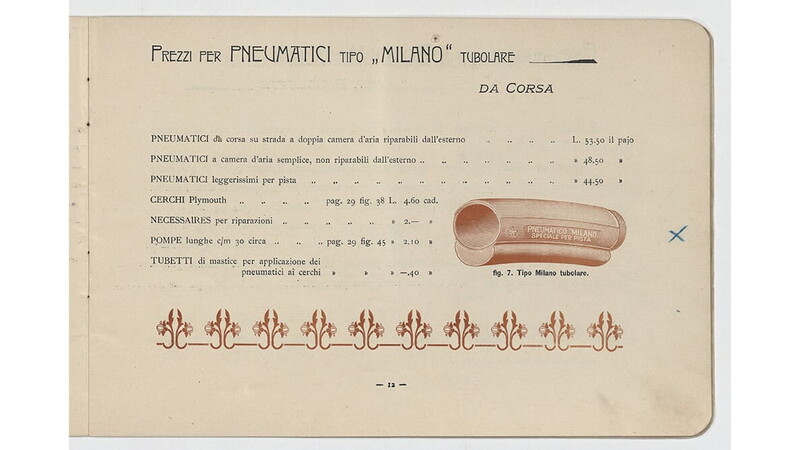
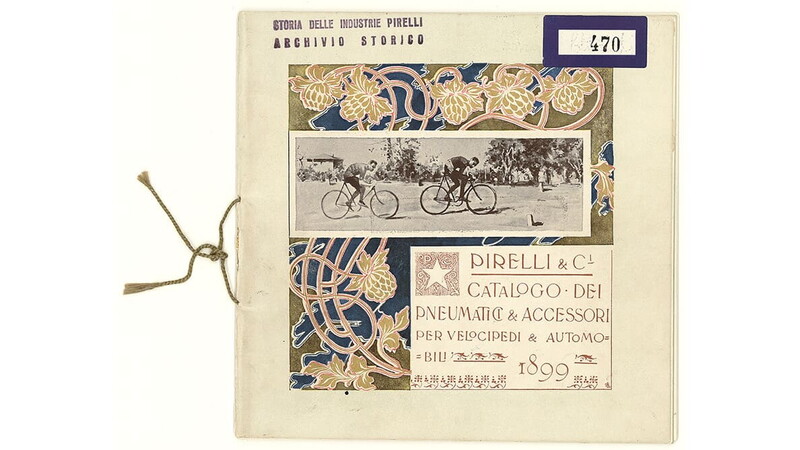
Back then, the roads were not asphalted; they were gravel or cobblestone tracks, meaning punctures were extremely frequent. For this reason, cyclists carried at least two tubular tyres slung over their shoulders and others tied to the bike. Pirelli supplied the Bianchi team with racing tubulars glued to the rims, designed to withstand high pressure and resist the poor roads. The best-known model was the “Tipo Milano”, among the most reliable in national competitions, produced in the Pirelli plant in Bicocca (Milan).
The roads were brutal for punctures and could cause many withdrawals. Repairs were difficult: the mastic used to glue the tubulars had to dry while racing, and the first few kilometres were risky because the tyre could become detached. But to continue, they improvised in every way possible, perhaps sewing the inner tube or filling it with grass.
Kitted out like marines
To face the gruelling stages, cyclists were fully kitted out. In addition to tubulars, they carried: a leather bag on the handlebars with bottles and water bottles; a small backpack to store provisions (hard-boiled eggs, chicken, rice cake, jam and butter sandwiches, sugar, bananas); in the front jersey pocket were the topographical maps and fresh eggs; in the back pockets were small bottles of coffee.
Stage one: rain, mud, cold and nails
In hindsight, one might think the first stage was organised to thin out the group of cyclists, perhaps to streamline the management of the Giro: from Milan to Cuneo along a 420 km route, with a pass over 2,000 metres above sea level. The start was just after midnight (all starts occurred at night due to the distances) - a highly difficult situation given the technology of the time, with very weak lights that barely illuminated two metres of road, making it even harder to find route markers.
After about an hour of pedalling, the first major difficulties struck: lightning, thunder, gusts of wind, and torrential rain hit the group of 81 starters, none of whom, obviously, had a cape for protection. The storm lasted all day, turning the unpaved roads into muddy swamps, creating difficulties even for the support vehicles.
Then there were the nails. Sometimes it was a prank by louts who enjoyed seeing the cyclists frustrated by punctures; sometimes it was sabotage by those who disliked the commotion generated by the Giro. Many had to stop repeatedly to repair tyres, and many were left without spare tubulars - a serious risk that could jeopardise their continuation in the Giro.
40 km of climbing
After nearly 200 km of torment through rain and mud, the group arrived in Susa, where the climb began: 40 km of slippery, icy gravel track, with sections to be scaled on a bicycle weighing over 15 kg, burdened with tubulars, tools, water bottles, and food strapped to the back. Some fell, some walked bent by the wind, some fell asleep in the saddle or leaning against walls. And at the top section, the mountain pass had to be faced in the rain, mud, and snow.
After two hours of climbing, the snowstorm arrived. They had to face it with all their energy because they understood it could already be the turning point of the Giro: whoever lost too much time here might not recover. There were famous crises, notably those of Girardengo and Ganna, who nonetheless did not abandon the Giro.
The first to crest the summit, pushing his bike by hand, was Angelo Gremo, Ganna's team-mate, who then gave way. And Ganna, in his Gatsby cap, short shorts, and a cape over his contorted face, jumped on his bike and flew towards Pinerolo on the muddy road, made even more slippery by the rain.
44 riders withdrew; the selection had only just begun.
Endless stages and endless breakaways
On the second day, bad weather continued to plague the survivors, and another 10 withdrawals were counted, including Ganna, due to unbearable pain in his legs. They were spared the third stage, the longest of the Giro: a massive 430 km from Lucca to Rome. Here, Lauro Bordin achieved one of the most legendary breakaways in Giro history. Shortly after the start, he jumped a level crossing while the group waited for the barriers to lift, and he exploited the small advantage (a few minutes) for a 350 km solo escape. They caught up with him after 14 hours, within sight of the finish in Rome. And he was grateful: he couldn't stand being alone any more.
The fourth stage, finishing in Naples, was “only” 327 km, intense due to accumulated fatigue, and the first crises began. The heat enveloped their legs, and some swore it would be their last stage. They were lying.
The fifth stage, from Naples to Bari, severely tested the tyres due to an extremely rough surface of stones and potholes under a relentless white sky. The strongest survived: Alfonso Calzolari, solid and silent, seemed not to feel any tiredness. Great names gave way. Girardengo stopped due to severe leg pain. He cried with disappointment, but it was just one episode in his career: he went on to dominate national cycling in the 1920s.
And then there were eight
Stage 6, from Bari to L'Aquila, saw the Apennines show no mercy, and the selection continued. It rained, the mud trapped the wheels, and only 12 arrived in L'Aquila; the mountain either breaks or tempers, and 5 more riders withdrew.
Stage 7, from L'Aquila to Bologna, crossed half of Italy from South to North, running through the night, dawn, sunset, and night again. It was long, 429 km, but no one had the desire to fight any more; the outcome was settled. Amid immense fatigue, pain and accidents, 4 more cyclists abandoned the Giro. The finish line in Milan was in sight. They reached it from Lugo, covering another 429 km, which for Calzolari was a mere stroll, finishing almost two hours ahead of the second-place rider. He won without conquering a single stage, but with exceptional regularity and tenacity.
The Giro concluded at the Velodromo Sempione, with the final spectacle of a one-lap time trial. The 8 survivors arrived in pitiful condition: their faces wrinkled, their eyes sunken, some unable to stand, others bearing the marks of bad crashes. They were welcomed as heroes. No other Giro would ever be like it again. A challenge beyond limits.
Pos. Rider Total time
1. Alfonso Calzolari 135h 04′ 19″
2. Pierino Albini +1h 57′ 26″
3. Luigi Lucotti +2h 04′ 23″
4. Giuseppe Azzini +2h 29′ 57″
5. Angelo Gremo +3h 35′ 38″
6. Carlo Galetti +3h 53′ 08″
7. Carlo Oriani +4h 16′ 39″
8. Giovanni Cervi +6h 12′ 18″
Photo courtesy of: www.fondazionepirelli.org