The inner workings of a Formula 1 Grand Prix
Although the Sunday event is the most eagerly anticipated moment of every racing weekend, die-hard fans know that it is worth tuning into Formula 1 a few days beforehand. Action on the track is spread over three days, in a crescendo of thrill and excitement for the first and second free practice sessions on Friday, the last free practice session and the qualifying session on Saturday culminating with the actual race on Sunday. Every day offers quite a spectacle and every stage of preparation is useful to attempt to predict the winners. And of course, you don't need an excuse to enjoy watching the 22 best drivers in the world at work. Ahead of the start of the season, here is how a Formula 1 Grand Prix works to help you navigate what is happening on the track during the entire weekend.

FREE PRACTICE SESSIONS
Every Formula 1 Grand Prix opens with the free practice sessions, which are also known by the abbreviation FP. A total of three practice sessions are held over the weekend, hence the names FP1, FP2, FP3. The first two sessions take place on Friday, while the third session is on Saturday and ends two hours before the qualifying session. As the name suggests, these sessions are used by the teams as a sort of dress rehearsal for the Grand Prix. During the 60-minute sessions, drivers push their cars to understand the track's nuances. It is a crucial window for understanding tyre degradation and fine-tuning the setup before the stakes get higher.
QUALIFYING SESSION
The competition gets into full swing on Saturday, after the last free practice session with the qualifying sessions, one of the most popular moments of the weekend for fans that determines the order in which the drivers will line up on the starting grid for the race. The concept is a simple one. The faster you go during the qualifying session, the better your position will be on the grid. The fastest of all earns the pole position, that is the first position and the Pirelli Pole Position Award.
The qualifying session is divided into three stages: Q1, Q2 and Q3. During Q1, the 22 drivers in the race have 18 minutes to drive on the track and try to set a lap time that will allow them to be among the top 15. When time runs out, the five worst drivers are excluded from the next stage and will start from the last five positions on the grid. The same happens during Q2, which lasts 15 minutes and aims to exclude five more drivers, who will start between 11th and 16th position. In Q3, which has been extended to 13 minutes for 2026, the final 10 drivers compete for the top ten spots. At this stage, the starting order is finalized—pending any penalties—and the fastest driver earns pole position and the Pirelli Pole Position Award.
SPRINT QUALIFYING
The new Sprint Qualifying system was introduced for some events of the session in 2021 to add an element of novelty, make the race weekend even more exciting, and refresh the Friday and Saturday schedules. In 2026, a Sprint weekend consists of a single free practice session on Friday followed directly by the Sprint Qualifying session, which follows a different format than the standard qualifying on Saturday.
The Sprint Qualifying stages are named SQ1, SQ2, and SQ3 (SQ stands for Sprint Qualifying). These sessions are shorter than the traditional Saturday qualifying:
• SQ1 duration: 12 minutes
• SQ2 duration: 10 minutes
• SQ3 duration: 8 minutes
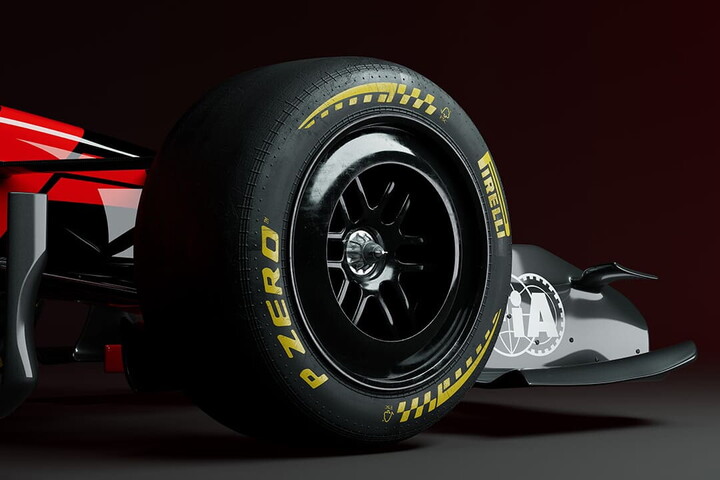
A key technical requirement during Sprint Qualifying is that drivers are obligated to use a new set of Pirelli Medium (Yellow) compounds during both SQ1 and SQ2. This adds another strategic tire element to the Formula 1 weekend. The Sprint Qualifying results determine the starting grid for the Sprint race the following day. For statistical purposes, the fastest driver in SQ3 is credited with pole position, though this does not determine the starting order for the main Grand Prix on Sunday.
The Sprint Race itself takes place on Saturday before the main Qualifying session. It is a 100 km short-form race, and the top eight finishers earn points toward the World Championship standings.

THE RACE
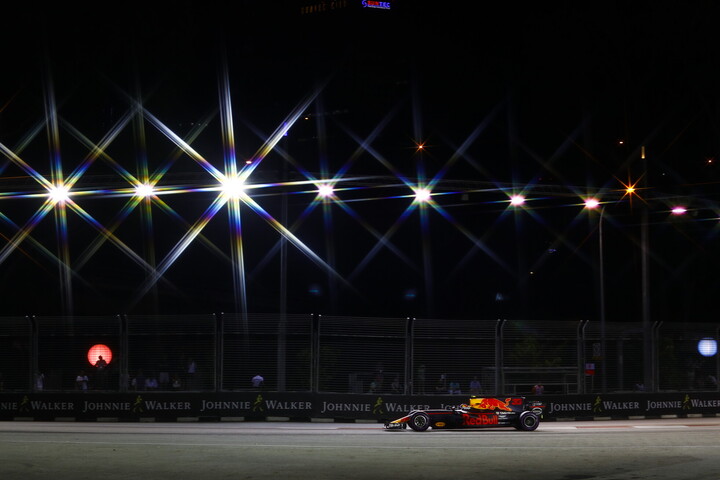
The race is usually held on Sunday afternoon, except for some stages, such as Singapore and Las Vegas, which are run at night. The cars must line up on the starting grid 30 minutes before the start. If a driver is still in the pit lane at that moment, he will start the race from there. In the minutes leading up to the start, the mechanics can move around the grid and make any necessary final tweaks and teams have until three minutes before the start to change tyres.
When one minute to go, only the drivers in their cars should be on the starting grid, ready for the formation lap. During this lap, they drive at a moderate speed without overtaking, allowing them to perform final system checks and warm up their tyres before the race begins.
Once the parade lap has been completed, the drivers take their places and wait for the start indicated by a traffic light with ten red signals, arranged in two rows of five. After turning on one at a time, they all switch off together and the Grand Prix officially begins. The time and distance of each race vary according to the track. As a rule, a Grand Prix must cover the minimum number of laps required to exceed a total distance of 305 kilometres. The Monaco Grand Prix is the sole exception, with a shorter distance of approximately 260 kilometres. In terms of duration, a race must be completed within a two-hour window of actual racing time. However, in the event of long suspensions (such as heavy rain or accidents), the total elapsed time from the start to the finish cannot exceed three hours.